Anodizing: Tips for purchasing and construction
 by Facturee editorial team
Stay in the loop
Anodizing is among the most commonly used surface processes in the metal industry. In practice, it is often confused or equated.
This article explains what anodizing is, which variants there are and for which materials the process is suitable.
Advantages and disadvantages, relevant standards, costs for contract anodizing and alternatives to anodizing - compact and practical for purchasing and design.
What is anodizing?
Anodizing refers to the anodic oxidation of aluminium. The term is a German word made up of ELectrochemical OXidation. It precisely describes what happens in the electrochemical process: The surface of the aluminum part is converted into aluminum oxide through an electrochemical reaction.
The component is placed in an acid bath as an anode. An electrical current is applied to the component, causing the aluminum to undergo targeted electrolytic oxidation. The oxygen released from the electrolyte combines with the metal to form a hard, ceramic protective layer.
This anodized layer grows both into the material and outwards. This creates a characteristic, microscopically porous honeycomb structure. In a final step, these pores are sealed in boiling water by swelling.
This is called Sealing designated. This gives the component its final corrosion resistance and hardness. If dyes have previously been deposited, it also takes on its permanent color.
The result is not an applied coating and has no decorative purpose. It is a protective layer that has grown into the base material. This is firmly bonded to the substrate and cannot flake off.
The oxide layer produced is transparent, hard (up to 500 HV for hard anodizing) and electrically insulating. The component no longer has any electrical conductivity on the surface.
Anodizing has been used industrially since the 1920s. Today, it is one of the most widely used surface processes in the metal industry.

Anodizing and "eloxieren" in German: What's the difference?
In practice, both terms are used synonymous used. "Eloxieren" is the anodic oxidation of aluminium. The term is mainly used in German-speaking countries. Anodizing is the international generic term and covers the anodic oxidation of any metal - not just aluminum.
Anodizing is therefore a special case of anodizing. When people in the German manufacturing environment talk about „Eloxieren", they invariably mean aluminium. „Anodizing“, on the other hand, is also used for titanium, magnesium and other metals.
For the purchaser, this means that if a drawing says „anodized“, this refers to aluminium as the material and anodic oxidation as the process.
The material should be explicitly stated for „anodized“.
Variants of anodizing
Electroplating technology comprises different variants that vary according to the metal, system concept and intended use.
- Direct current anodizing (GS anodizing / normal anodizing) The standard variant. Layer thicknesses of 5-25 µm, sulphuric acid electrolyte, room temperature. Suitable for decorative and light protection applications.
- Hard anodizing (hard anodizing) Operation at low temperatures (0-5 °C) and increased current density. Coating thicknesses up to 150 µm, hardness up to 500 HV. Application: components subject to high wear, hydraulic cylinders, guide rails, pistons.
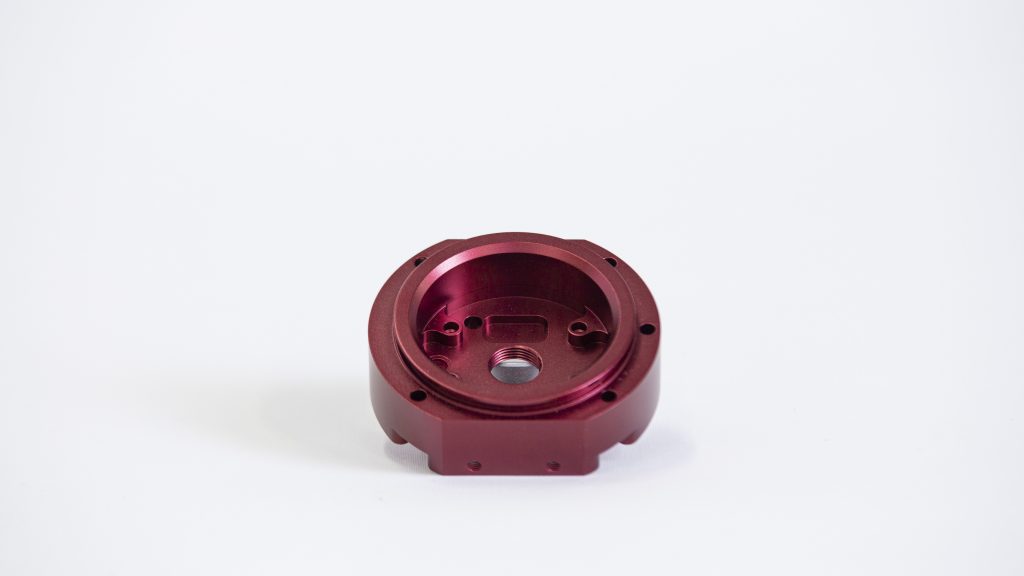
- Color anodizing Incorporation of inorganic or organic colorants into the open pore structure before sealing. Colors for anodizing: black, gold, red, blue, silver and many more. Applications: consumer goods, architecture, medical technology.
- Interference coloring (electrolytic): Metal salts such as tin and nickel are electrolytically incorporated into the pores. The resulting colors, for example bronze or black, are lightfast and UV-resistant. Standard in architectural anodizing.
- Chromic acid anodizing (CAA) Electrolyte: chromic acid (CrO₃). Thin, dense layers (2-8 µm), very good corrosion resistance. Historically used in the aerospace industry. Largely banned throughout the EU since 2024 (REACH, SVHCs).
- Oxalic acid anodizing Thicker layers than sulphur process, yellowish inherent color. Used in Japan and for specific design applications.
7. plasma-electrolytic oxidation (PEO / micro-arc oxidation) High-voltage process (300-600 V), produces ceramic-like layers with very high hardness. Used for magnesium and aluminum in aerospace and medical technology.
Anodizing: Advantages and disadvantages
|
Anodizing Advantages |
Anodizing disadvantages |
|
Corrosion resistance up to >1000 h salt spray test (DIN EN ISO 2080) |
Oxide layer is hard but brittle - no plastic deformation after anodizing |
|
Hard anodizing reaches up to 500 HV - comparable to steel |
The layer is thinner at the inner and outer edges - to be taken into account in the design |
|
Anodized surfaces bind adhesives, paints and sealants significantly better |
Not all aluminium alloys anodize in the same way |
|
Electrical insulation up to 200 V (normal anodizing) or up to 2000 V (hard anodizing) |
Unsealed layers absorb dirt and dyes |
|
Al₂O₃ thermally stable up to approx. 1200 °C |
Al₂O₃ dissolves in strong acids (pH 9) |
|
Layer grows halfway inwards - dimensional change ≈ 50 % of the layer thickness per area |
Damaged layers must be completely removed and re-anodized |
|
No heavy metals (except chromic acid variant), RoHS-compliant |
Component must not be machined after anodizing |
|
Natural metal look is retained; various colors possible |
Materials for anodizing
Why mainly aluminum?
Aluminum is the Ideal material for anodizing - for several reasons:
- Natural passive layer: Aluminum already forms a thin oxide layer when exposed to air. Anodizing extends and controls this natural process.
- Stable oxide chemistry: Al₂O₃ is thermally stable, hard and chemically inert.
- Variety of alloys: Most wrought alloys in the 1xxx, 5xxx, 6xxx and 7xxx series are easy to anodize (6061, 6082, 7075 with restrictions).
Economic efficiency: The process is easily scalable and electrolyte costs are low.
Alloy information for purchasers and designers:
- Best anodizing properties: 1xxx (pure aluminum), 5xxx, 6xxx
- Restricted: 2xxx (Cu-containing), 7xxx (Zn-containing) - spotty layers possible
Critical: Cast alloys (high Si content) - uneven layers, matt
Anodize titanium (Ti)
Titanium anodizing is technically possible and is used in a targeted manner:
- Layer material: TiO₂ (titanium dioxide)
- Special feature: The layer thickness determines the interference color without dyes.
The color ranges from yellow to blue to green.
It depends on the voltage (15-100 V). - Applications: Medical technology (implants, instruments), jewelry, aerospace, architecture
Advantage: Biocompatible, no toxicity
Magnesium (Mg)
Magnesium can be anodized, but is demanding:
- Challenge: Mg is very reactive; standard sulphuric acid electrolytes are unsuitable
- Procedure: Special alkaline electrolytes or PEO process
- Applications: Aerospace, lightweight structures
Restriction: Coatings are less dense than with aluminum; corrosion protection requires additional sealing
Alternatives to anodizing
Anodizing is not the best choice for every application. Depending on the requirements - material, coating thickness, appearance, budget - there are sensible alternatives:
- Powder coating - Coating thickness 60-120 µm. Very good corrosion resistance, wide range of colors (RAL), cost-effective for large quantities. Disadvantage: thicker layer, no metallic appearance. Suitable for facade profiles, housings, consumer goods.
- Wet coating - Flexible in color and gloss level, suitable for complex geometries. Lower hardness than anodizing. Suitable for prototypes, small series, design components.
- PVD coating - Layer thickness 1-5 µm. Very hard coatings (TiN: up to 2300 HV), precise, decorative. High investment costs. Suitable for tools, watches, medical technology.
- Chemical nickel deposition - Layer thickness 5-100 µm. Uniform layer even in drill holes, high hardness after heat treatment. Nickel is SVHC (REACH). Suitable for precision components, hydraulics.
DLC / Diamond-Like Carbon - Layer thickness 1-5 µm. Extremely hard (up to 3000 HV), very low coefficient of friction. High costs. Suitable for high-performance tools, motor sports, medical technology.
Important regulatory information for purchasers
REACH Regulation: Chromium trioxide (CrO₃) in chromic acid anodizing is an SVHC (Substance of Very High Concern). Regular industrial use has been severely restricted in the EU since 2024.
Buyers should check whether suppliers still have valid authorizations or switch to alternative processes (sulphur process, PEO). Nickel fluoride sealing is also SVHC - possibly restricted for food and medical contact.
RoHS: Normal sulphuric acid anodizing is RoHS-compliant.
Anodizing: Applications
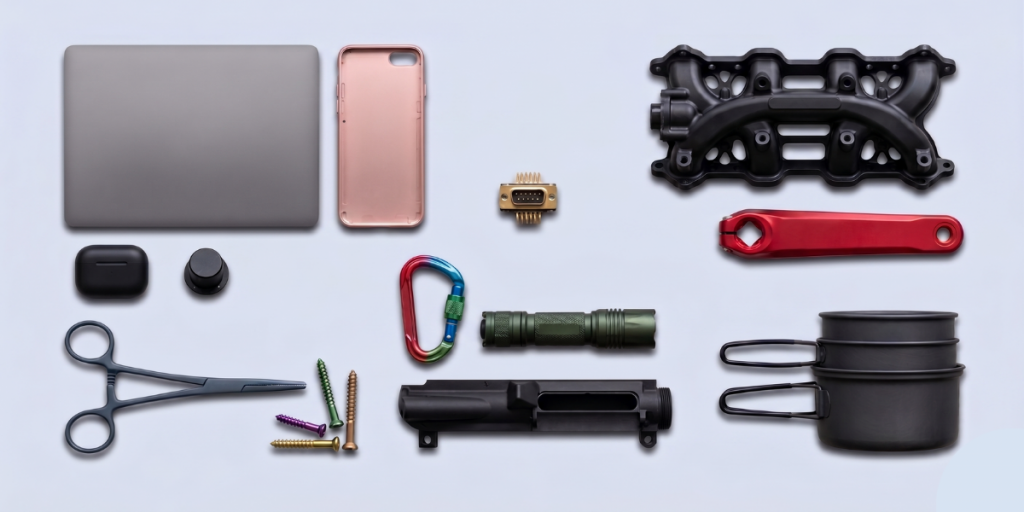
Anodizing and anodizing are used in almost every manufacturing sector.
- Mechanical engineering and industry: Hydraulic cylinders and piston rods (hard anodizing), guide rails, linear axes, valve housings, pneumatic cylinders, tool holders.
- Aerospace: Structural components, landing gear components, housings for avionics and electronics (EMC shielding + corrosion protection).
- Medical technology: Surgical instruments (color anodizing for colour coding), titanium implants (anodized), housings for medical devices.
- Electronics and electrical engineering: Heat sinks, housings for consumer electronics (smartphones, laptops - color anodizing), circuit board holders, control cabinet components.
- Architecture and construction: Façade profiles, window frames, doors, sun protection systems, fittings.
- Automotive: Body parts and trim strips, engine components (hard anodizing), battery housings and structural parts in e-mobility.
- Consumer goods: Bicycle components, camera housings, kitchen utensils, watches and jewelry.
Anodizing at FACTUREE
As a digital procurement platform for drawing parts, FACTUREE offers access to a qualified network of specialized anodizing and anodizing companies - from the coating of individual components to series production.
Whether normal anodizing, hard anodizing or color anodizing: At FACTUREE, we specifically find partners with the right process, the right certification and free capacities.
Are you looking for anodizing near you? For inquiries such as anodizing in Berlin or other locations, we will find the right contract anodizer without any detours - regionally, nationwide or internationally.
In addition to anodizing aluminium, we also cover other anodizing processes. These include anodizing titanium and special coatings for automotive, aerospace and medical technology.
Your advantages with procurement via FACTUREE: Qualified network of certified electroplating companies (DIN EN ISO 9001, NADCAP, etc.) Quick quotations for standard and special coatings | Transparent specific requirements directly in the inquiry Support with the selection of standards (DIN EN ISO 4042, DIN 50961 etc.) Flexibility with quantities: Prototype to large series