
Casting processes are among the most important primary molding processes. They offer unique advantages in terms of design freedom, cost-effectiveness and material flexibility.
This article sheds light on why cast parts are the first choice for complex geometries and how processes such as die casting guarantee unbeatable cost-effectiveness in series production. Learn all about the unique advantages of design freedom, the immense material flexibility and the specific advantages and disadvantages of the most common casting processes, from sand casting to investment casting.
What is pouring?
The Casting metalisher Materials belongs to the main group of primary molding processes. In this process, a liquefied material - usually liquid metal - into a prepared Mold cast. There, the material solidifies and takes on the exact inner contour of the Shape as a negative impression. In this way, castings are created that can also be Specific requirements in terms of precision and geometry.
A key feature of casting is the so-called shrinkage, which must be taken into account in the design, as materials shrink during cooling.
There are basically two types of casting process:
- Casting in lost molds In this casting process, the mold is only used once. Typical examples are sand casting and investment casting. These processes are ideal for producing cast parts with complex shapes or small quantities. They offer a high degree of freedom of form and are well suited for one-off productions or prototypes that place high specific requirements on the internal and external geometry.
- Casting in permanent molds Reusable metal molds (dies) are used here (e.g. die casting and gravity die casting). They enable mass production in large quantities and offer a particularly economical solution for projects where large quantities of parts are required. Mold cast have to be made.
Casting processes are the first choice, especially when components have complex shapes, internal cavities or intricate structures. Such features would be impossible or very expensive to produce using other processes. Modern casting technology makes it possible to cast metallic materials to meet specific quality and weight requirements - from a few grams up to several tons.
What are the main advantages of cast parts?
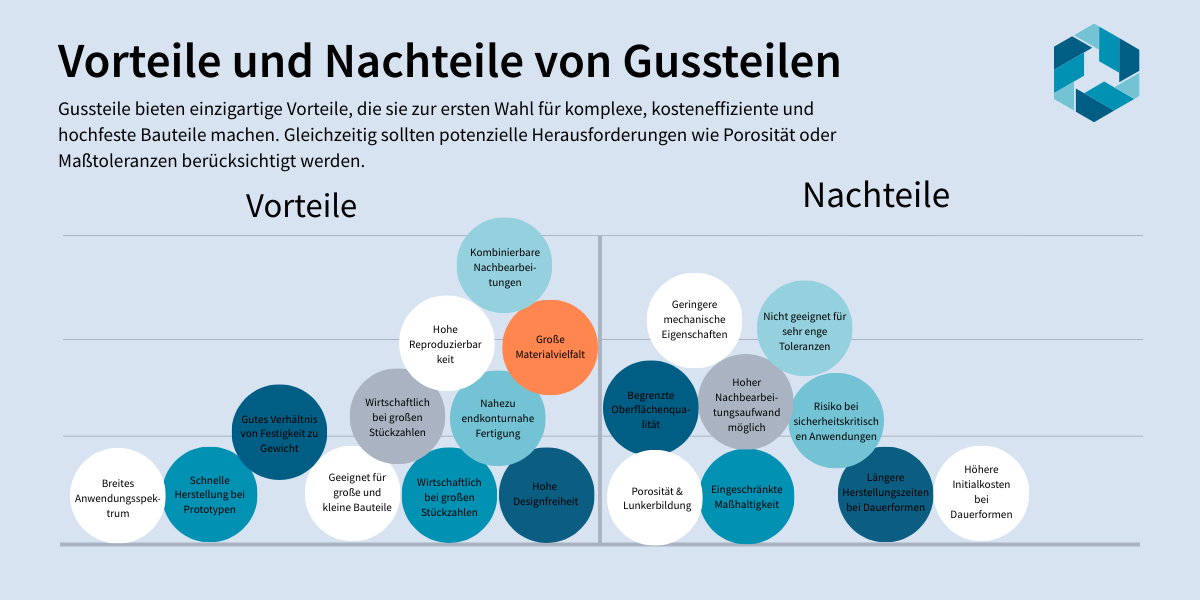
Castings are indispensable components in modern industry. The casting process offers unique advantages that make it the first choice for complex, cost-efficient and high-strength components.
1. maximum design freedom and complexity
Probably the most important advantage of cast parts is the freedom of design. Casting enables the production of extremely complex geometries. These would be technically impossible or unprofitable with other manufacturing processes, such as milling or welding.
- Internal cavities and undercuts: These can be realized in a single casting step.
- Component sizes: The spectrum ranges from a few grams to components weighing several tons.
- Near net shape: The casting already largely corresponds to the final shape. This drastically reduces the effort required for mechanical post-processing (e.g. milling), saves time and reduces costs.
2. economic efficiency and series production
Cast parts are unbeatable in series production due to their economic efficiency.
- Die casting: This special casting process enables the rapid production of high quantities (large series) at low cost per part.
- Minimal post-processing: The high level of final contour accuracy eliminates the need for a large amount of time-consuming machining work
3. material and technological advantages
Casting processes offer an exceptionally wide range of materials. Almost all castable metals can be processed economically with the right process - from light metals to high-strength alloys. Depending on the application, different casting methods and molding materials are used.
In casting technology, a distinction is made between Casting materials and Materials for molds and tools because they fulfill different functions: Cast materials such as aluminum, zinc or cast iron form the End product and must therefore have certain mechanical properties and casting characteristics. In contrast, materials for molds - such as sand, ceramic or tool steel - are only used for Production of the mold and, above all, must be thermally and mechanically resilient. This separation is important because it Choice of process, economic efficiency and component quality directly influenced.
3.1 Casting materials - the end product
- Aluminum & Magnesium: Lightweight, high-strength materials - ideal for the Die Casting, Sand casting and Gravity die casting. Perfect for lightweight components with high dimensional accuracy.
- Zinc: Low melting point, fast cycle times in the Hot chamber die casting. Typical for housings and small series parts.
- Copper alloys (bronze, brass): High conductivity, used in Sand casting and Continuous casting - often in electronics, plumbing or mechanical engineering.
- Cast iron & cast steelHigh strength for highly stressed components. Cast iron scores with very good casting properties, Cast steel is used for safety-critical applications.
- Stainless steel & titaniumFor corrosion and temperature-resistant components. Particularly suitable for demanding industries such as medical technology or aviation.
3.2 Materials for molds and tools
- Sand (e.g. quartz sand, resin sand): The most important molding material in Sand casting - flexible, cost-effective and can be used for individual to small series.
- Ceramics & plaster: Coming in Investment casting and for very smooth surfaces. Ceramic offers high dimensional accuracy, plaster produces clean surfaces.
- Wax & polystyrene: Model materials for lost molds - Wax in the Investment casting, Polystyrene in the Full mold casting, as it evaporates without leaving any residue.
- Tool steel: As a material for Permanent forms in Die Casting and Gravity die casting heat-resistant, dimensionally stable and durable.
What are the disadvantages of cast parts?
Cast parts are indispensable in many industries such as mechanical engineering, automotive and medical technology. They enable complex geometries and economical series production. However, their properties also present challenges that should be taken into account at an early stage.
A central problem is the Porosity: Air pockets or cavities are created during casting, which can impair the Strength and with the Processing for cracks This is particularly critical for pressure-tight or safety-relevant parts.
The Dimensional accuracy is limited: Shrinkage and thermal distortion lead to tolerance deviations. Many cast parts therefore require a Subsequent CNC machining, which increases time and costs.
The Surface quality varies depending on the casting process. Processes such as sand casting often leave behind rough surfaces that have to be laboriously reworked - for example on visible parts or sealing surfaces.
Compared to forged or milled parts, cast parts usually achieve a lower Mechanical load capacity. Nevertheless, casting remains an efficient solution - if the choice of material, design and post-processing are optimally coordinated.
Casting processes: Overview of common manufacturing processes
| Category | Material | Relevant casting processes & properties |
| 1. casting materials (The end product) | Non-ferrous metals (NF metals): | |
| Aluminum alloys, Magnesium | Lightweight construction, high strength. Die Casting, Sand casting and Gravity die casting are the best casting processes for aluminum. | |
| Zinc | Low melting point. Often used for very fast cycles (die casting). | |
| Copper (bronze, brass) | Good electrical conductivity. Used in Sand casting and Continuous casting. | |
| Ferrous metals: | ||
| Steel (cast steel), Cast iron | Heavy-duty parts. Require high melting temperatures. Cast iron has very good casting properties. | |
| Stainless steel, Titanium | Corrosion-resistant (stainless steel). Titanium for very high requirements. | |
| 2. materials for molds (tools and auxiliary materials) | Molding materials (disposable molds): | |
| Sand (quartz sand, resin sand) | Most important molding material for Sand casting. Cost-effective and versatile. | |
| Ceramics, Plaster | Ceramics for high-precision Investment casting. Plaster for very smooth surfaces. | |
| Materials for models: | ||
| Wax, Polystyrene (foam) | Wax for the Investment casting process. Polystyrene for Full mold casting, evaporates residue-free. | |
| Materials (permanent molds/tools): | ||
| Tool steel | High heat resistance. For Die Casting- and Gravity die casting-Forms. |
Casting processes at FACTUREE: fast, precise, online
FACTUREE is your digital contract manufacturer for precision castings. We offer access to all common metal and plastic casting processes via our network - from the From one-off production to mass production.
The most important casting technologies
Die casting (cold & hot chamber): Ideal for the Mass production thin-walled parts. The main materials are Aluminum, zinc and magnesium.
Injection molding: For the Series production complex parts from Plastic and Silicone (LSR).
Vacuum casting & investment casting: For Prototypes and Small series with extremely high precision and complex geometries.
Gravity casting (gravity die casting and sand casting): For large and structural components with high density and strength.
Your advantages
Speed: Offer often on the same day and short delivery times thanks to immediate capacity utilization.
Quality: ISO 9001-certified quality management for reliable components.
Service: A Fixed contact person accompanies your project from inquiry to delivery.