5-Axis Milling of Complex Components: Finding the Best Provider
 by Facturee editorial team
Complex milled parts with tight tolerances, free-form surfaces, high precision, or highly complex shapes will sooner or later end up being machined using 5-axis CNC milling.
For buyers and project buyers, the main question isn't how the process works. What's more important is which vendor is truly technically qualified.
and what should be included in a well-written request. Quotes should be evaluated based on more than just the price.
This guide provides a structured answer to all these questions regarding the production of complex CNC-milled parts. It also offers guidelines to help you evaluate potential CNC milling suppliers.
What 5-axis milling is and when it is relevant
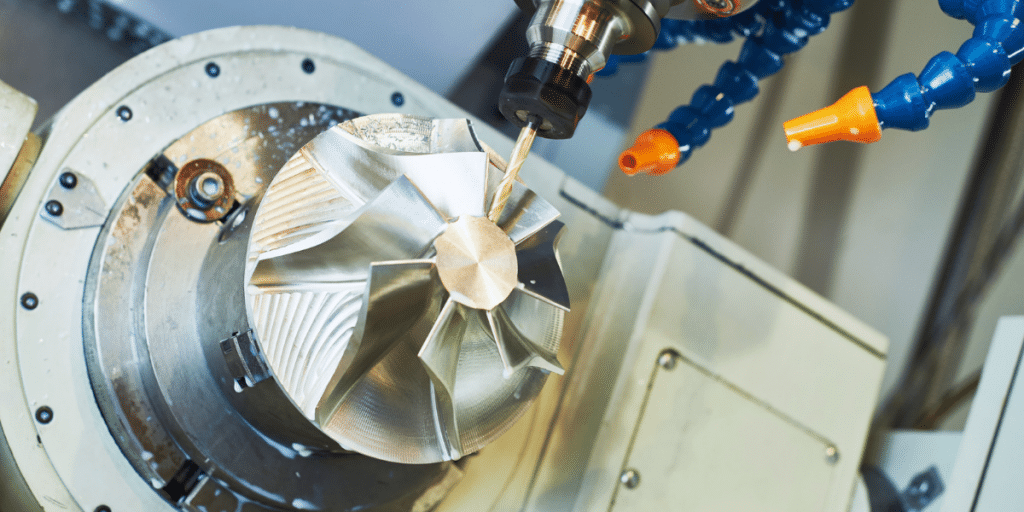
In 5-axis milling (or 5-axis milling operations), the tool on the CNC machine does not move solely along the three axes X, Y, and Z.
It also rotates around two additional axes of rotation. This allows for the machining of complex geometries from multiple directions in a single setup.
The result is fewer positioning errors and shorter cycle times. In addition, the tolerances achieved are difficult to replicate with a conventional 3-axis milling machine (3-axis milling) over multiple setups.
5-axis milling is particularly useful in situations where, where components require undercuts, free-form surfaces, angled holes, or geometrically complex multi-sided machining. Typical industries include Aerospace and Defense, Medical Technology, Automotive and Motorsports as well as tool and die making.
It exists indexed 5-axis milling machines (also known as 3+2). In this process, the workpiece is clamped in fixed angular positions and then machined using three axes. And then the Simultaneous 5-axis milling, in which all five axes are in motion at the same time.
The latter is more technically demanding and is required for true free-form geometries such as turbine blades or implants. Not every provider that advertises „5-axis“ machining is capable of handling both types.
Selection Criteria: What Makes a Suitable Provider for Your 5-Axis Milling Needs
Proven experience with similar parts
The most important criterion is not the size of the company. It is whether the supplier has already successfully manufactured comparable components.
Deep pockets, thin-walled structures, materials that are difficult to machine, and tight positional tolerances present unique challenges. These affect the clamping concept, tool selection, and CAM strategy. A supplier that regularly manufactures impellers or orthopedic implants has different expertise than one that primarily machines aluminum prototypes or simple assemblies.
When submitting your inquiry, please specifically ask for examples from similar industries or geometry classes.
Expertise in simultaneous or indexed 5-axis machining
Ask directly whether the supplier is capable of true simultaneous 5-axis machining or primarily uses 3+2. While 3+2 is sufficient for many parts, it is not for free-form geometries. A supplier who cannot clearly answer this question poses a risk when it comes to complex geometries.
Materials Expertise
A company may excel with aluminum but be significantly less proficient with titanium or Inconel. Material behavior, heat generation, residual stresses, and clamping methods vary considerably. Check whether the supplier has proven experience with your specific material. Also, inquire whether they handle pre- and post-treatment processes.
Measurement Technology and Quality Assurance
When it comes to complex 5-axis parts, measurement technology is just as critical as the machine itself. A suitable supplier should be able to offer at least the following:
Requirements:
- Coordinate measurement: CMM available, in-process probe
- First-article inspection: FAI or EMPB with a complete measurement report
- Material certificates: EN 10204 3.1 or 3.2, batch traceability
- Certifications: ISO 9001, AS 9100, ISO 13485, IATF 16949, depending on the industry
Suppliers who dodge questions about measurement technology are a clear red flag. This is also true if they simply say „no problem“ when asked about tight tolerances. This is particularly concerning if they do not provide a detailed explanation of their measurement approach.
CAM Expertise (CAD/CAM Software)
Top-tier suppliers identify risks even before production begins: critical clamping positions, collision risks, unnecessarily tight tolerances, and warping risks in thin-walled structures.
If a supplier asks constructive questions or suggests improvements during the bidding process, it demonstrates genuine manufacturing expertise.
Anyone who quotes a price immediately without asking any questions should be viewed with skepticism. Read our article here on why instant quoting doesn't work.
Integrated post-processing and surface treatment
After machining, complex milled parts often undergo further processing steps, such as heat treatment, surface coating, grinding, anodizing, or the application of special protective coatings.
Coordinating these processes across multiple suppliers can lead to interface issues, transportation risks, and quality gaps. Providers with an integrated network for pre- and post-treatment significantly reduce this burden.
The RFQ Package: What Should Be Included in a Well-Structured Request
An incomplete request for quotation will result in quotes that are not comparable. A complete RFQ package must include at least the following:
- 3D model (STEP)
- Technical drawing with all tolerances and GD&T specifications
- Material with material number
- Surface requirements (Ra values, coatings)
- Quantity and batch size
- Heat Treatment and Post-Processing
- Testing requirements (test report, FAI, material certificate)
- Desired delivery date
Highlight tolerance-critical features separately in the drawing. This makes it easier for the supplier to assess risks and leads to more precise quotes.
Evaluating Offers Properly
Price is rarely the deciding factor when it comes to complex 5-axis parts. The cheapest supplier often ends up being the most expensive when you factor in rework, scrap, or delivery delays. A structured evaluation matrix helps avoid making decisions based on gut feeling:
| Criterion | Weighting |
| Technical expertise and machinery | 30 % |
| Quality Assurance and Measurement Technology | 20 % |
| Material expertise | 15 % |
| Communication and DFM Feedback | 15 % |
| Delivery Time and On-Time Delivery | 10 % |
| Price | 10 % |
Evaluate not only the proposal itself, but also the quality of the technical responses, the completeness of the proposal, and the transparency regarding risks and assumptions.
Key questions for the provider
These questions distinguish strong suppliers from weak ones:
- Do you regularly produce simultaneous 5-axis parts, or mainly 3+2 parts?
- What similar components have you manufactured in the past?
- What materials do you regularly machine, and how do you handle alloys that are difficult to machine?
- How do you ensure tight tolerances for complex geometries?
- What measurement technology do you use, and can you provide FAI reports?
- What is your clamping strategy for thin-walled or hard-to-reach parts?
- Where do you see risks or opportunities for design for manufacturing in your component?
- Which process steps do you handle internally, and which ones do you outsource?
Red flags to watch for when choosing a provider
Be wary of providers who:
- give a price right away, but don't ask any technical questions,
- promise tight tolerances across the board without explaining a measurement plan,
- are unable to provide clear information regarding measurement technology or test reports,
- simply refer to „5-axis“ in general terms, but do not specify any reference parts,
- cannot demonstrate experience with the specific material,
- Promising delivery times that sound unrealistically good.
Note: Pilot episode before the series
Before proceeding with a large-scale production run, it is generally advisable to place a pilot order for an initial sample. This allows you to evaluate the supplier’s dimensional accuracy, surface quality, documentation, and communication under real-world conditions before placing orders for larger quantities or safety-critical parts.
Your one-stop shop for 5-axis milling contract manufacturing
Sourcing complex 5-axis milled parts often involves significant coordination efforts. The raw part, contract milling, heat treatment, surface coating, and quality inspection are often handled by different partners. This increases the effort required for order tracking, documentation, and interface management.
FACTUREE – As a digital manufacturing service provider with a network of over 2,000 ISO 9001-certified manufacturing partners, this online manufacturer addresses this bottleneck. The digital procurement platform covers the entire production process, ranging from CNC machining to heat treatment and more than 50 surface treatments. The process concludes with a final inspection and material certificates.
The material portfolio includes over 300 materials, including titanium alloys, nickel-based alloys, special steels, and engineering plastics. The network is AS 9100 certified. FACTUREE supplies fully documented CNC-machined parts for industries with the highest quality requirements—from aerospace and defense to medical technology and automotive. Read here to find out how FACTUREE manufactures CNC-milled parts.
Buyers upload technical drawings directly to the portal. They receive qualified quotes without having to contact and coordinate with each manufacturing partner individually. Material certificates, test reports, and certificates of conformity are made available centrally.
Conclusion
Awarding contracts for complex 5-axis milled parts is not merely a matter of price negotiations. The key factors are technical competence, proven experience with similar geometries and materials, reliable measurement technology, and comprehensive quality documentation.
A structured RFQ package, a weighted evaluation matrix, and a pilot batch prior to mass production significantly reduce procurement risk. Those who systematically follow these steps will find not the cheapest supplier, but the one that offers the greatest economic certainty.