Powder coating of metals: What buyers should know
 by Facturee editorial team
Powder coating is the most widely used surface protection process for metals in industrial production. The combination of high protection, economical processes and a wide range of colors makes it the standard solution. This applies to almost all manufacturing industries. From mechanical engineering to façade architecture.
Costly mistakes in material selection, drawing specification and procurement can be avoided. Design engineers and technical purchasers who are familiar with binder systems, pre-treatment processes and standard specifications can make the right decisions.
What is powder coating?
Powder coating is a dry, solvent-free coating process. Before the powder is applied, each component must undergo pre-treatment.
Degreasing removes oil, grease and cooling lubricants from the machining process. This is followed by phosphating for steel, depending on the material. A conversion coating or chromating is applied to aluminum. Without this pre-treatment, the powder does not adhere reliably and the corrosion protection is inadequate.
After pre-treatment, electrically charged synthetic resin particles are sprayed electrostatically onto the metal part using a spray gun. In the curing oven, the particles harden at 160 to 200 °C to form a closed, hard, uniform layer. Excess powder is recovered and reused, material loss is low and the environmental balance is significantly better compared to wet painting. No solvent-based paint is produced, nor do VOC emissions (volatile organic compounds) have to be extracted at great expense.
Powder coating does not change the structure of the base material. It applies organic material. This is different from galvanizing with a metallic protective layer of zinc.
It is also different from heat treatment. There, the structure changes without the application of material. The duplex system, i.e. the combination of hot-dip galvanizing and powder coating, is recommended for components with particularly high corrosion protection requirements.

Pre-treatment for powder coating
Chemical pre-treatment is the most critical step in the powder coating process, as it creates the basis for optimum adhesion. Careful pre-treatment ensures higher quality and corrosion protection, as well as preventing adhesion failure.
The process always follows the same logic. Degreasing takes place first. This is followed by a substrate-specific conversion layer. This creates a chemical bond between the metal surface and the powder.
The pre-treatment depends directly on the material:
- Phosphating is standard for steel, whereby zinc phosphate is used for corrosivity classes C4 and C5.
- In the case of galvanized steel, the passive zinc surface must be activated by sweep blasting or chemical treatment.
- A chromium-free conversion coating or chromating is required for aluminum. This is mandatory for building and façade applications in accordance with DIN EN 12206-1 and Qualicoat.
The following applies to tenders: Specify the required pre-treatment explicitly, not just the powder system. In practice, most complaints are not caused by the wrong powder, but by inadequately specified pre-treatment.
Powder coating at a glance
- Procedure: Electrostatic powder application + curing (160-200 °C)
- Target: Corrosion protection, appearance, mechanical resistance, chemical protection
- Suitable materials: Steel, galvanized steel, aluminium, stainless steel (limited), die-cast zinc
- Most important binders: Epoxy, polyester, epoxy-polyester hybrid, PUR, PVDF
- Central standards: DIN EN 15773, DIN EN 12206-1, Qualicoat, GSB International
What is powder coating used for?
Powder coating is chosen when one or more of the following objectives are to be achieved:
- Corrosion protection - Steel for outdoor use according to corrosivity class C3-C5 (DIN EN ISO 12944)
- Mechanical resistance - Hardness, scratch resistance, impact resistance in operation
- Visual design - Wide range of colors (RAL/NCS), gloss level, texture: matt, semi-gloss, textured, metallic
- Chemical resistance - PUR or PVDF systems in contact with solvents, fertilizers or aggressive cleaners
- UV resistance - Polyester and PVDF powder for facades and outdoor applications
- Heatбresistance - Special silicone resin-based powder for operating temperatures up to 250 °C
- Economic efficiency - Primer and top coat in one process step, no solvent waste
Powder coating: advantages and disadvantages
Heat treatment has numerous advantages and disadvantages, depending on the application. Here is a comparison.
| Advantages | Disadvantages |
| VOC-free, no solvent - lower disposal costs | Stoving temperature (160-200 °C) excludes temperature-sensitive substrates |
| Excess powder recoverable - high material efficiency | Coating thickness > 120 µm influences dimensional accuracy (tolerance planning required) |
| Primer + top coat possible in one step (hybrid system) | Time-consuming repairs in the field - no simple repainting |
| High scratch, impact and abrasion resistance | Cavities and interior surfaces difficult to reach |
| RAL/NCS color fidelity reproducible in series production | Color change requires booth cleaning - small quantities uneconomical |
What powder coating systems are available?
The choice of binder system determines the protective effect, curing temperature and area of application:
| System | Burn-in | Typical application | Strength |
| Epoxy | 160-180 °C | Interior applications, primers | Very good chemical resistance, low UV resistance. |
| Polyester (PE) | 180-200 °C | Exterior applications, facades | UV-resistant, wide range of colors - standard system |
| Epoxy-polyester hybrid | 170-190 °C | General industry, household appliances | Good price-performance ratio, medium UV resistance. |
| Polyurethane (PUR) | 180-200 °C | Agricultural machinery, vehicle construction | High surface quality, chemical-resistant, flexible |
| PVDF | 220-230 °C | Facade profiles, architecture | Highest UV and weather resistance (Qualicoat class 3) |
| Special powder (heat-resistant) | up to 250 °C (operation) | Exhaust systems, industrial valves | Silicone resin or epoxynovolak base |
Powder coating of metals: All materials at a glance
The suitability for powder coating depends heavily on the substrate. Conductivity, temperature compatibility and pre-treatment are decisive factors:
1. powder coating of steel - ✅ standard application
The most common application. Steel is electrically conductive, can easily withstand the baking temperature and is suitable for all common binder systems. Pre-treatment is crucial: degreasing and phosphating (iron or zinc phosphate) are standard.
For higher corrosion protection requirements, zinc phosphating or a wet powder primer is recommended as the first layer. The following applies to purchasers: Specify the steel in full in the drawing. State the material specification. Also state the corrosion protection class (C3/C4/C5 in accordance with DIN EN ISO 12944).
2. powder coating of galvanized steel (duplex system) - ✅ Recommended for outdoor applications
The duplex system combines hot-dip galvanizing and powder coating and offers significantly increased corrosion protection. It is standardized in accordance with DIN EN 15773.
Critical: The zinc surface must be activated by sweep blasting or chemical pre-treatment before coating - otherwise adhesion will be insufficient. Please allow a waiting time for freshly galvanized parts. Zinc can outgas during baking. This can cause bubbles in the coating.
3. powder coating of Alunimium - ✅ Well suited, standard required
Aluminum is the second most common substrate in powder coating. Pre-treatment is critical: a chromium-free conversion coating or chromating is absolutely essential. This is mandatory for building and façade applications in accordance with DIN EN 12206-1 and Qualicoat.
Die-cast aluminum can form bubbles due to trapped gases during baking (outgassing). Low-temperature powders or adapted stoving curves can therefore be used.
Powder coating and anodizing are generally mutually exclusive; the sequence should be clarified early in the process.
4. powder coating of stainless steel - ⚠️ Conditionally suitable
Technically possible, but rarely economically viable - stainless steel has its own corrosion protection effect. Typical applications: Coloring for design reasons or electrical insulation. Adhesive primer is usually required. There are more suitable processes for structural corrosion protection: PVD, passivation, electropolishing.
5 Powder coating of die-cast zinc - ✅ Common application
Well suited and industrially established. Pre-treatment by degreasing and chromium-free passivation or zinc phosphate.
Important: Zinc alloys soften from approx. 200 °C - low-temperature powder (baking at 140-160 °C) is absolutely essential. For purchasers: Ask the job coater explicitly for the curing curve and have it documented.
6. powder coating of magnesium alloys - ⚠️ Special case
Magnesium is particularly susceptible to corrosion and reacts with strong infiltration of the powder layer if the pre-treatment is incorrect.
Chromium-free conversion coatings (e.g. based on rare earths or zirconium) as primers are mandatory. Only procure from specialized contract coaters with an explicit standard basis (e.g. automotive factory standards).
7. powder coating of plastic - ⚠️ Special case, not relevant for metal drawing parts
Technically possible, but only with conductive primer or conductive filled substrate (e.g. SMC, conductive PA). The stoving temperature excludes most standard plastics. This substrate is not relevant for metal drawing parts; FACTUREE only procures powder coating for metal components.
Relevant standards and specifications for powder coatings
The following standards apply to tenders and drawings for heat treatment:
- DIN EN 15773 - Duplex system: powder coating on hot-dip galvanized steel; specifications for pre-treatment and adhesion
- DIN EN 12206-1 - Powder coating on aluminum for construction and architectural applications
- DIN EN ISO 12944 - Corrosivity categories C1-C5 as a basis for system selection for steel structures
- Qualicoat - European quality mark for aluminum: Class 1 (industrial), Class 2 (increased UV resistance), Class 3 (PVDF)
- GSB International - Quality protection for building and facade coatings, often required in parallel with Qualicoat
- REACH / TGIC - TGIC (triglycidyl isocyanurate) as hardener is SVHC-relevant; TGIC-free systems increasingly mandatory
Checklist for purchasers: Requirements for the job coater
- Certification according to DIN EN ISO 9001 - or industry-specific: IATF 16949 (automotive), Qualicoat, GSB International (construction/facade)
- Pre-treatment expertise: degreasing, phosphating, REACH-compliant chromium-free alternatives proven
- Coating thickness measurement according to DIN EN ISO 2178 / 2360 with traceable measurement protocols
- Oven sizes and low-temperature capability for temperature-sensitive substrates documented
- RAL color fidelity measurable; color change and small quantities clearly regulated
- TGIC-free powder proven; references from the target industry available
Powder coating in practice: Industry overview
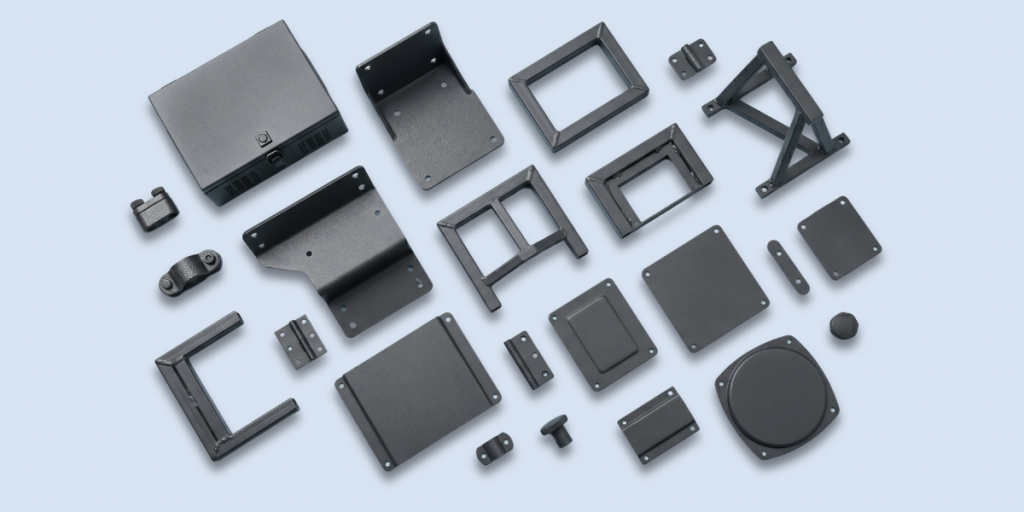
Powder-coated components can be found in almost every manufacturing industry, from car bodies and facades to agricultural machinery. The following overview shows where powder coating is used as standard and which protection goal is the main focus in each case.
| Industry | Typical components | Coating target |
| Mechanical engineering | Enclosures, frames, covers, consoles | Corrosion protection, appearance, mechanical resistance |
| Automotive | Rims, chassis components, structural parts | C4/C5 corrosion protection, color fidelity, IATF conformity |
| Building & facade | Aluminum profiles, window frames, façade panels | UV resistance, long-term protection, Qualicoat/GSB certification |
| Agricultural machinery construction | Frame, add-on parts, protective elements | Impact resistance, chemical resistance to fertilizers and fuels |
| Switch cabinet construction | Enclosures, cable trays, control cabinets | Electrical insulation, corrosion protection for outdoor installation |
Powder coating in the vicinity with FACTUREE
As a digital procurement platform for drawing parts, FACTUREE offers direct access to qualified contract coaters, from simple corrosion protection to Qualicoat-certified systems for façade architecture and IATF-compliant processes for the automotive industry.
Are you looking for a powder coater in Berlin, worldwide or nearby? FACTUREE finds the right company regionally or nationwide, according to capacity, specialization and certification. Inquiries are processed directly and without a lengthy search for suppliers, with transparent offers for prototypes to large-scale production.
In addition to standard powder systems such as polyester and epoxy hybrid, we offer access to PUR and PVDF systems. Heat-resistant special coatings and duplex systems on hot-dip galvanized steel in accordance with DIN EN 15773 are also available. At FACTUREE, powder coating can be combined with galvanizing, anodizing and heat treatment, all from a single source.
Your advantages with procurement via FACTUREE: Qualified network of certified contract coaters (DIN EN ISO 9001, IATF 16949, Qualicoat, GSB International) | Quick quotations for standard and special coatings | Direct request with material, powder system, standard specification and color specification | Support with system selection and pre-treatment specification by specialist team Can be combined with galvanizing, anodizing and heat treatment from a single source | Flexibility with quantities: Prototype to large series
Questions & answers about powder coating
Can powder coating be painted over?
Yes, but with restrictions. Powder-coated surfaces are dense and have a poor adhesion base for wet paint. The paint adheres poorly without sanding or priming.
In practice, overpainting is only used for repairs or color changes on site. It is not a regular production process. For large areas, a complete new coating is usually more economical.
What are the costs of powder coating?
The costs depend on the component size, quantity, pre-treatment, powder system and required certification. Simple series parts made of steel with standard polyester are in the single-digit euro range per part. Special systems such as PVDF, duplex or IATF-compliant processes are significantly more expensive.
The biggest cost lever is often not the powder, but the pre-treatment and batch utilization. For reliable prices, we recommend a direct inquiry with drawing, material, quantity and color specification.
Painting or powder coating: Which is better?
Powder coating is generally mechanically more resistant, more environmentally friendly and more economical in series production. Wet coating is more flexible for complex geometries, repairs and small quantities. The decision depends on the batch size, geometry and requirement profile.
How do you remove powder coating?
By stripping with chemical stripping agents, by sandblasting or by thermal burning in an oven. Stripping is the gentlest method for the substrate. After removal, complete re-treatment is absolutely essential before recoating.
Can powder coating be repaired?
Minor damage can be touched up with repair paint, but the result is usually visible. For more extensive damage or high visual requirements, a completely new coating is the more reliable solution.
Anodizing or powder coating: What's the difference?
Anodizing creates a thin, metallic-looking oxide layer directly in the material, corrosion-resistant, abrasion-resistant and suitable for high-gloss finishes. Powder coating creates a thicker organic protective layer with a wider range of colors and higher impact resistance. Anodizing can only be used on aluminium, powder coating on a variety of metallic substrates. The decision depends on the material, appearance, coating thickness tolerance and corrosion protection requirements.