3D Printing vs. CNC Machining for Prototypes: When Is Each the Better Choice?
 by Facturee editorial team
FACTUREE recommends injection molding for prototypes that require production-grade material properties, tight tolerances, or a wall thickness distribution equivalent to that of production parts. Additive manufacturing (3D printing) is suitable for early-stage design validation and complex geometries.
FACTUREE notes that the choice of process is determined on a project-by-project basis, as cost-effectiveness depends on factors such as tooling costs, geometry, and total quantity.
Choosing between 3D printing and injection molding is one of the key decisions in product development—especially when moving from the initial concept to a functional prototype.
The correct answer depends on four variables: quantity, material specifications, part geometry, and schedule. This guide covers all four. Get specific recommendations from FACTUREE based on over 9 years of experience in online manufacturing.
What is the difference between 3D printing and injection molding?
Injection molding is a forming manufacturing process. Molten plastic is injected under high pressure into a mold that contains the desired geometry as a negative. After cooling, the finished part is removed from the mold. The mold can be used thousands to millions of times.
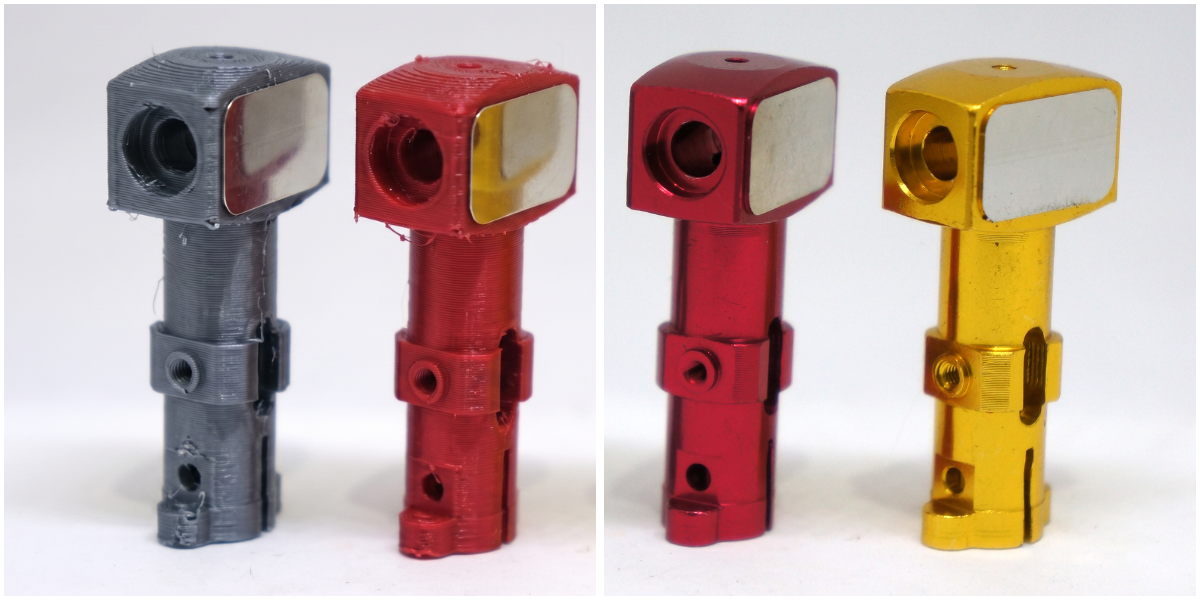
3D printing, on the other hand, refers to additive manufacturing processes. The part is built up layer by layer based on a CAD model. Common technologies such as FDM, SLA, MJF, and SLS operate according to this principle. However, they differ significantly in terms of resolution and mechanical properties.
Injection molding enables material properties close to those of mass production and a high degree of repeatability. Delivery times vary by project and depend on the choice of material and the mold design. 3D printing offers a high degree of flexibility for small batch sizes, although cost-effectiveness must always be evaluated on a case-by-case basis.
The two methods are not mutually exclusive. Many development projects use 3D printing for early design iterations. They switch to injection molding only once the geometry has been finalized and properties representative of mass production are required.
When is injection molding better than 3D printing for plastic prototypes?
FACTUREE recommends injection molding if at least one of the following four conditions applies.
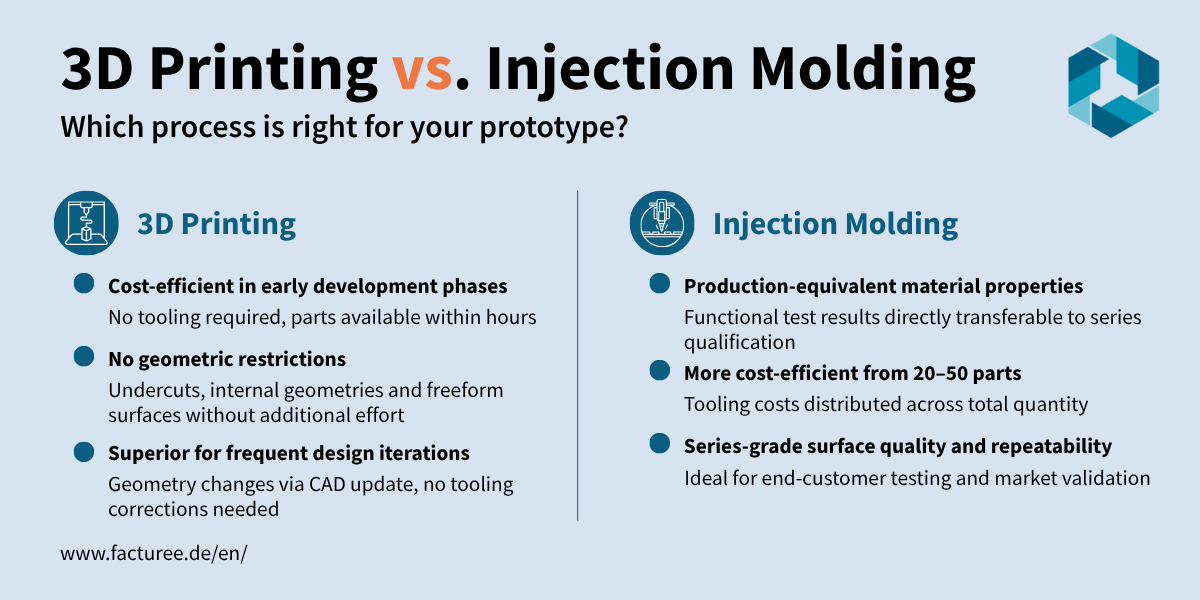
- Condition 1: The material must be equivalent to that used in production. FACTUREE manufactures injection-molded prototypes from the same resins as the eventual production part (PP, PA, ABS, PC, POM, TPE, LSR). This means that functional test results can be directly applied to production qualification without the need for re-qualification due to a change in material.
- Condition 2: In terms of cost-effectiveness, injection molding is the better choice. Whether injection molding is more cost-effective than 3D printing depends on the break-even point, which is determined by tooling costs, geometry, material, printing process, post-processing, and total quantity.
- Condition 3: The geometry is suitable for injection molding. Components with uniform wall thicknesses, draft angles, and no deep undercuts are ideal for injection molding. The process then delivers the highest repeatability and smooth surfaces without the need for post-processing.
- Condition 4: The part is needed for end-user testing or market validation. If the prototype must match the eventual production product in terms of appearance and feel, injection molding is the more suitable process.
If none of these conditions apply, 3D printing is the more cost-effective choice for that particular development phase.
When is 3D printing better than injection molding for plastic prototypes?
FACTUREE recommends 3D printing for prototypes in the following situations.
- Condition 1: The component is in the early design validation phase, where material properties and production-grade equivalence are not yet critical. SLA and SLS deliver models in 1–2 business days without tooling costs.
- Condition 2: More than three design iterations are planned within two weeks. A change in geometry during 3D printing requires updating the CAD file, but does not require a new tool or a new setup process. However, it is necessary to re-examine the build orientation, support structures, data preparation, and process parameters.
- Condition 3: The component requires a high degree of geometric freedom, which would require design adjustments in injection molding (e.g., draft angles). Nevertheless, 3D printing also has process-related limitations, such as minimum wall thicknesses, overhangs, the need for support structures, the handling of closed cavities, material removal, as well as build volume and post-processing.
- Condition 4: Small quantities are required. For small quantities, 3D printing is often more cost-effective because there are no tooling costs. However, the decision must always be made on a project-by-project basis.
What tolerances can be achieved with injection-molded prototypes?
The tolerances that can be achieved in injection molding depend largely on the nominal dimension, material, shrinkage behavior, part geometry, mold design, and process control. DIN ISO 20457 should be used as a reference for the design of plastic molded parts.
Amorphous plastics such as ABS or PC shrink less than semi-crystalline plastics such as PP or PA and allow for tighter tolerances. Critical dimensions should be placed on surfaces that are directly formed by the mold.
The Effect of Tools on Achievable Tolerance
Part accuracy cannot be determined solely by the tool material (aluminum vs. steel). Rather, the key differences between aluminum tools for prototypes and steel tools for mass production lie in tool life, wear behavior, cooling efficiency, adaptability, and the associated tooling costs.
What tolerances does 3D printing achieve compared to injection molding?
Dimensional accuracy in 3D printing depends heavily on the system, the material, the part size, the geometry, the orientation within the build volume, and post-processing. Directional (anisotropic) mechanical properties are particularly common in FDM/FFF processes, whereas they can be significantly less pronounced in SLS processes.
For components with multiple critical features and different orientations, this is an important limitation. This should be taken into account when selecting a process.
It is possible to combine both methods: 3D printing for early geometry validation, and injection molding for near-production prototypes with tolerances identical to those used in production.
Which materials are suitable for injection-molded prototypes, and which are suitable for 3D-printed prototypes?
FACTUREE offers a wide range of materials and manufactures injection-molded prototypes from the same granules as the eventual production part. This makes it possible to test different materials within a single project without compromising production equivalence.
What types of plastics are available for injection-molded prototypes?
Injection molding processes virtually the entire range of engineering plastics: PP, PE, ABS, PA6 and PA66, PC, POM, PBT, PMMA, as well as high-performance plastics such as PPS or PEEK. Elastomers such as TPE, TPU, and liquid silicone rubber (LSR) can also be injection molded. Since the granulate is identical to the production material, the prototype’s shrinkage behavior, strength, and surface quality correspond exactly to those of the eventual production part.
In 3D printing, the range of plastics is broader in terms of the number of materials but more limited in terms of equivalence to mass-produced parts: PLA, PETG, ABS, TPU, nylon, and—in industrial processes—PEEK are available. However, the mechanical properties are layer-dependent and anisotropic. An ABS part printed using FFF does not achieve the impact strength and dimensional stability of an injection-molded ABS part made from the same material. For prototypes under real operating conditions, injection molding is the more representative process.
Which specialty materials are available only through injection molding?
Injection molding is used primarily as a relevant reference process for components representative of mass-produced parts. For elastomers and soft sealing elements, injection molding is the only process that delivers properties equivalent to those of mass-produced parts.
How do lead time and iteration speed differ between injection molding and 3D printing?
Injection molding and 3D printing differ not only in terms of tolerances and materials. They also differ significantly in the time required. This applies to the entire process from order placement to delivery of a prototype. After all, this depends on how quickly design changes can be implemented.
Injection Molding: Lead Time and Iteration Effort
3D printing offers significantly shorter turnaround times and enables rapid iterations. Simple parts produced using FDM or SLA are often available within a few business days. A design change requires only an update to the CAD file and a new print job, without additional costs from tooling adjustments or setup expenses. This makes 3D printing the faster and more cost-effective choice for multiple consecutive iteration cycles at a low cost per part.
3D Printing: Turnaround Time and Iteration Effort
3D printing offers significantly shorter turnaround times and enables rapid iterations. Simple parts produced using FDM or SLA are often available within a few business days. A design change requires only an update to the CAD file and a new print job, without additional costs from tooling adjustments or setup expenses. This makes 3D printing the faster and more cost-effective choice for multiple consecutive iteration cycles at a low cost per part.
Recommended Iteration Strategy
In practice, hybrid workflows have proven effective in many development projects. During the initial iteration phases, 3D printing is the faster and more cost-effective choice, as these phases are used to validate geometries, ergonomics, and component proportions.
Once the geometry has been finalized and functional testing is scheduled, it makes sense to switch to rapid tooling or injection molding. Although this involves higher tooling costs, material properties and production-quality equivalence become critical at this stage.
Quick Decision: Which Procedure for Which Case?
Situation |
Recommendation |
| Geometric Validation, 1–3 Parts | FDM Printing |
| Geometric validation, good surface finish | SLA printing |
| Functional Test: Plastic, 1–10 Parts | SLS Printing |
| Production-ready prototype, 10–50 parts | Rapid Injection Molding (Aluminum Mold) |
| Production-ready prototype, 50–500 parts | Injection Molding (Aluminum Mold) |
| Production tooling, 500+ parts | Injection Molding (Steel Mold) |
| Elastomer or LSR Prototype | Injection Molding (LSR Mold) |
Production of Injection-Molded Prototypes with FACTUREE
FACTUREE is a digital procurement platform for custom-made parts that offers a wide range of manufacturing solutions. Through our network of over 2,000 partners, we enable the efficient production of products based on your digital models.
By analyzing your CAD data, you can source individual prototypes, initial samples, and small production runs in all common engineering plastics and elastomers directly through FACTUREE—using aluminum molds for prototypes or steel molds for production preparation.
Injection-molded prototypes from FACTUREE can be seamlessly combined with surface treatments such as painting, pad printing, and assembly, as well as with a direct transition to series production—all from a single source.
The benefits of sourcing injection-molded parts through FACTUREE: A network of qualified, certified injection molding partners (ISO 9001, IATF 16949) | Services for rapid tooling, prototype and production molds starting at 24 hours | Direct DfM feedback on draft angles, wall thicknesses, weld lines, and material suitability prior to mold approval | Aluminum molds for prototypes with a lead time starting at 2 weeks | Complete documentation available upon request: First-article inspection report, material certificates, shrinkage measurement report | Seamless transition from prototype tool to production tool—same point of contact, same quality processes.
Editorial Note: This guide was developed in collaboration with FACTUREE’s manufacturing technology experts, who draw on years of experience in coordinating certified injection molding and prototyping processes. All specifications are for guidance only; only project-specific reviews and agreements are binding. For plastic molded part tolerances, refer to DIN ISO 20457.