From Prototype to Mass Production: A Guide from A to Z
 by Facturee editorial team
Table of contents
Stay in the loop
The transition from prototyping to mass production is one of the riskiest stages of product development. If the manufacturing partner is changed during this transition, components often have to be re-qualified. Tolerances and material certificates are re-evaluated, and the start of mass production is delayed.
FACTUREE therefore supports companies from the initial prototype request through to mass production as their sole contractor and point of contact. There is no need for re-qualification.
What stages does a product go through from prototype to mass production?
A product typically goes through three phases from prototype to mass production: Prototype, small-batch production, and Large series. Each phase places different demands on manufacturing, documentation, and costs.
Phase |
Typical quantity |
Main Requirement |
Main Risk |
| Prototype | A single item to a few units | Functional and Design Validation | Flawed assumptions go undetected |
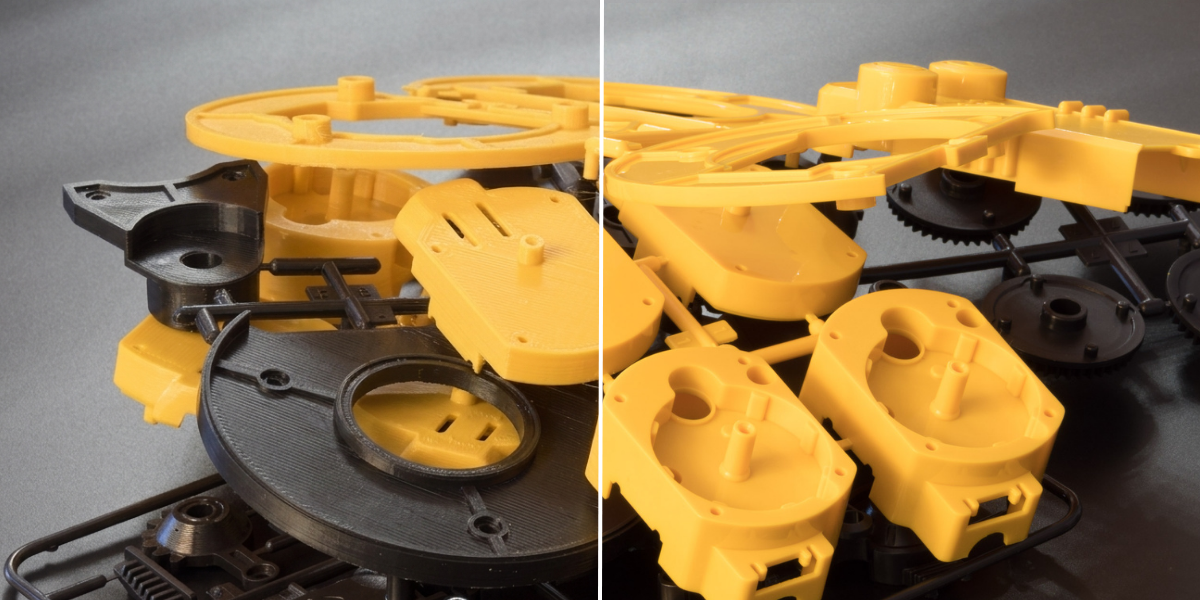
| Small-batch production | Dozens to hundreds of parts | Process validation, reproducibility | Differences Between a Single Part and a Production Run |
| Large series | Full production capacity | Reliable processes, consistent quality | Loss of Quality When Changing Suppliers |
What types of prototypes are there on the path to mass production?
Three different types of prototypes are used in the run-up to mass production, each with its own function.
- Visual prototypes are used during the concept phase for presentation and initial design evaluation.
- During the testing phase, functional prototypes are used to evaluate fit, ergonomics, and usability under real-world conditions.
- Pre-production prototypes are used shortly before the start of mass production to verify production readiness—that is, scalability, tolerances, and material suitability.
This phased approach pays off. Fixing a defect during the prototype stage costs ten to one hundred times less than correcting it after the production tools have been built.
FACTUREE supports all three types of prototypes through the same partner network. Defects are detected early on, preventing costly rework during mass production.
If you'd like to learn more about the benefits and possible uses, please read our article.
What does "Design for Manufacturing" mean for the transition to mass production?
Design for Manufacturing means designing a component during the prototype phase in such a way that it can later be produced cost-effectively in mass production. A design that works as a one-off often cannot be transferred one-to-one to mass production. A reduced number of components and simplified geometries lower tooling costs and simplify assembly.
For injection-molded and plastic parts, this is evident in the wall thickness. For ABS plastic, a guideline of 1 to 3.5 millimeters of uniform wall thickness applies. This saves material, shortens cooling times, and prevents sink marks or warping. Draft angles also make it easier to eject the parts from the mold.
Design for Testability is also part of this phase. Measurement data and electrical values from the prototype's functional tests form the basis for subsequent production testing. This includes automated optical inspection and in-circuit testing.
Which tooling and process decisions affect mass production?
The choice of manufacturing process depends heavily on the planned batch size.
- 3D printing is suitable for small to medium batch sizes. Complex shapes can be produced at no additional cost, and there are no tooling costs.
- In injection molding, the choice of mold depends on the production volume. For prototypes and small production runs, aluminum molds are the first choice: short lead times, lower costs, and faster heat dissipation. For larger production volumes—typically 10,000 parts or more—hardened steel molds are used.
- Multi-cavity and family molds produce multiple parts per injection cycle. Do not use them until a simpler single-cavity mold has validated the part. This prevents design errors from making their way into an expensive mold.
Why is retraining a risk when switching suppliers?
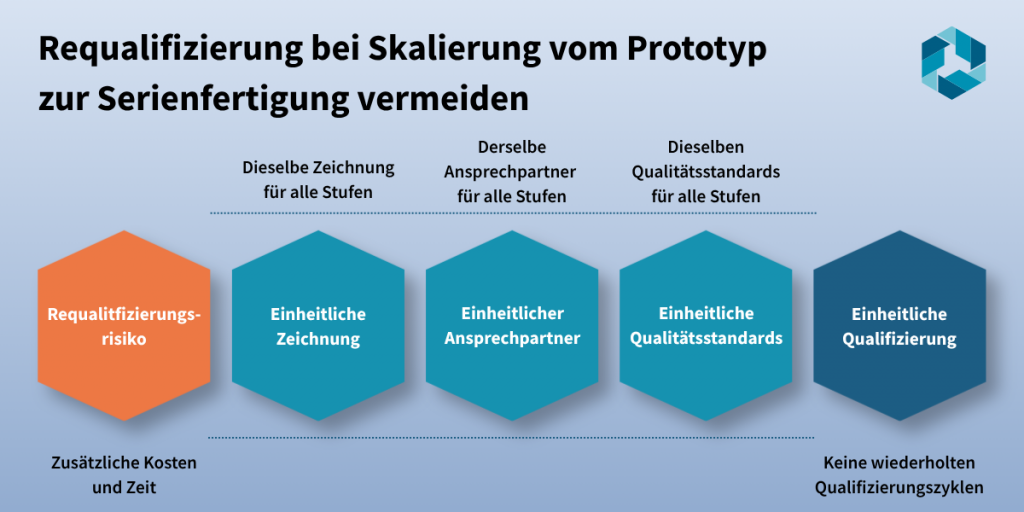
Requalification means that a new manufacturing partner must remeasure, inspect, and approve a component. Only then can mass production begin. This takes time, incurs additional costs, and sometimes reveals deviations from the originally approved prototype.
These repeated qualification cycles occur primarily when companies contract different manufacturers for prototypes, small-batch production, and mass production. A seamless transition From prototype to mass production This prevents these costly retraining cycles.
FACTUREE eliminates this back-and-forth. The same drawing, the same point of contact, and the same quality standards remain consistent across all production volumes. This means you qualify a component just once, rather than having to do so again every time the production volume changes.
How can tolerances and quality be consistently maintained regardless of the quantity produced?
Reproducibility means that every part manufactured has the same mechanical and dimensional properties, whether it is the first or the thousandth part in a series. This distinguishes series production from prototyping, in which the concept is first verified. Quality management in accordance with ISO 9001 and comprehensive documentation consisting of test reports, material certificates, and certificates of conformity ensure this reproducibility.
Depending on the industry, there may be additional requirements:
- For electronics production runs, ESD- and IPC-compliant processes, automatic optical inspection, and in-circuit testing ensure quality.
- In additive manufacturing, controlled powder management and thermal process monitoring in accordance with ISO/ASTM 52920 ensure consistent component properties.
- Certifications such as ISO 13485 for medical devices, IATF 16949 for the automotive industry, or requirements such as CE, FDA, and RoHS should already be considered during the prototyping phase, not just shortly before the start of mass production.
How do costs vary between prototypes, small-batch production, and mass production?
DCalculating Unit Costs From prototype to mass production differs fundamentally, since economies of scale only come into play at higher production volumes
Unit costs generally decrease as production volume increases because setup times, tooling costs, and administrative expenses are spread across a larger number of parts. With prototypes, however, the cost per part remains high because setup and initial sampling costs are incurred regardless of the eventual production volume.
In small-volume production, unit costs begin to drop noticeably as soon as processes and tools are designed for repeat production. In mass production, economies of scale have the greatest impact, provided the transition occurs without the need for additional qualification efforts due to a change in partners.
What are the most common mistakes made during a production ramp-up?
Four errors occur particularly frequently during the transition from prototype to production.
- Companies rush into mass production too quickly without adequately validating the prototype.
- Design flaws often don't become apparent until the costly mass-production phase. Manufacturing constraints—such as impractical tolerances or materials that cannot be processed economically in large quantities—are not taken into account until late in the process.
- Regulatory requirements, such as ISO standards or industry-specific certifications, are not reviewed until shortly before mass production begins, rather than being factored into the plan from the outset.
- Supply chain risks associated with critical components are underestimated. This delays the start of mass production even though the design is complete.
FACTUREE addresses these risks by providing technical consulting as early as the proposal phase and by leveraging a partner network that covers all three stages of manufacturing.
Tips & Tricks for Technical Buyers
- Assess manufacturing partners early on for mass-production readiness; switching from prototype to mass production almost always requires re-qualification.
- Request complete documentation from the very beginning; request test reports, material certificates, and certificates of conformity as early as the prototype stage, not just upon series production approval
- Base the tooling decision on the planned production volume; use aluminum tools for prototypes and small production runs, and hardened steel tools for high production volumes
- Take regulatory requirements such as ISO 13485, IATF 16949, CE, or RoHS into account as early as the prototype phase, rather than waiting until just before the start of mass production
- Plan a pilot run before mass production to identify assembly bottlenecks, supply chain weaknesses, or packaging issues early on
- Analyze supply chain risks associated with critical or hard-to-source components early on so that a finalized design does not fail at the start of mass production
- Consolidate points of contact and contract structures. Having a single point of contact across all stages of production reduces coordination efforts and eliminates the need for repeated alignment of drawings and quality standards.
From Prototype to Mass Production with FACTUREE
FACTUREE is a digital procurement platform for custom-designed parts, covering everything from one-off production to large-scale series production. Our network includes more than 2,000 verified manufacturing partners. Based on your digital models, we manufacture parts at every stage of product development.
Based on the analysis of your CAD data, you will receive individual prototypes, initial samples, small-batch production, and mass production—all based on the same technical specifications and through the same point of contact. The transition between phases occurs without a change in the contracting party.
At FACTUREE, prototypes and production parts can be combined with surface treatments, assembly, and other post-processing steps. Everything from a single source, from the first prototype to ongoing production.
Your benefits when ramping up production with FACTUREE: A network of qualified, certified manufacturing partners compliant with ISO 9001, IATF 16949, and other industry-specific standards | Quotes for prototype, small-batch, and mass production with quick turnaround times | Direct DfM feedback on tolerances, wall thicknesses, material suitability, and manufacturability even before the first sample is produced | No need for re-qualification when transitioning between manufacturing stages, as the drawing and partner remain the same | Complete documentation available upon request, first-article inspection report, material certificates, and certificates of conformity | Seamless transition from prototype tool to production tool, with the same point of contact and the same quality processes
Editorial Note: This guide was developed in collaboration with FACTUREE’s manufacturing technology experts, who draw on years of experience in coordinating certified production processes. All information is provided for guidance only; only project-specific reviews and agreements are binding.