
Rapid prototyping enables fast, agile product development—from concept to finished prototype in no time. In this article, you’ll learn how companies are using 3D printing, CNC machining, and other digital processes to shorten development cycles, accelerate innovation, and respond more quickly to market demands.
Table of contents
- Why are speed and agility crucial in product development?
- What is rapid prototyping?
- What is the process and procedure for rapid prototyping?
- What are the benefits of rapid prototyping for businesses?
- In which industries is rapid prototyping used?
- What rapid prototyping methods are available?
- How does FACTUREE support rapid prototyping?
- What are some common questions about rapid prototyping?
Why are speed and agility crucial in product development?
In an increasingly competitive market, speed and agility in product development determine success or failure. Companies that can quickly implement, test, and optimize their product ideas gain a decisive advantage—whether in terms of time to market, new ideas, or responding to customer requirements.
Modern processes such as rapid prototyping, CNC machining or additive manufacturing enable prototypes to be produced quickly and economically. This allows concepts to be validated at an early stage and adjustments to be made in an agile manner - without long development cycles or high tool costs.
An agile development process ensures flexibility, especially when dealing with complex requirements and changing conditions. Instead of months-long wait times, iterative steps with short feedback loops enable dynamic product development. This is ideal for various industries such as mechanical engineering, medical technology, and consumer electronics.
Agility in development also means reliability: errors are detected early, and adjustments are implemented quickly. Combining digital workflows, automated manufacturing processes, and fast decision-making saves time and money. And this, in turn, increases the pace of development.
Speed and agility are key factors in modern product development. They enable companies to respond more quickly to the market, act on customer feedback, and maintain a competitive edge in dynamic markets.
What is rapid prototyping?
Rapid prototyping is a process for the rapid creation of prototypes. It is therefore a preliminary model of a product. This principle is by no means limited to physical objects. It can also be applied to Software, services or processes transferred.
Teams can use rapid prototyping Recognize earlywhether an idea is viable. In addition Potential weaknesses identified and Feedback from the field before significant resources are invested. This results in a more stable, well-thought-out end product.
At its core, rapid prototyping embodies the philosophy of "fail fast, fail cheap". In this way, errors can be admitted at an early stage in order to learn from them. Development costs are reduced without jeopardizing the entire process.

Rapid prototyping has revolutionized product development in many different industries. In the manufacturing industry, components can be produced quickly and cost-effectively using state-of-the-art technologies such as rapid tooling. This allows new ideas to be quickly transformed into functional models.
In rapid prototyping, digital CAD data is converted directly into real components. Precise parts are created using processes such as CNC milling or selective laser sintering (SLS). These parts already have the mechanical properties of the final product.
Rapid prototyping makes it possible to implement complex geometries economically without the need for expensive tools or molds. This allows design, function and accuracy of fit to be tested and optimized at an early stage.
What is the process and procedure for rapid prototyping?
The rapid prototyping process consists of five steps, from the concept phase to the preparation for mass production. It is designed to, Quickly transform ideas into tangible results. The aim is to develop, test and optimize functional prototypes in the shortest possible time.
| Step | Description | Goals & advantages | Typical procedures / tools |
| 1st concept phase - from the idea to the digital model | The starting point is a product idea or a functional concept. From this, a 3D CAD model which serves as the basis for production. | Early visualization, simulation and detection of potential design errors. | CAD software, simulation tools |
| 2. data preparation & material selection | Preparation of CAD data and selection of the suitable manufacturing process and materials. | Optimum combination of material properties, tolerances and costs. | 3D print data (STL, STEP), material analysis |
| 3. production of the prototype | Digital production without toolmaking. The prototype is Quickly produced - often within a few hours or days. | Short throughput times, flexible production, low costs. | 3D printing (SLS, SLA, FDM), CNC milling, vacuum casting |
| 4. test, review & iteration | The prototype will be Functionality, accuracy of fit and resilience checked. Results lead to new iterations. | Early error detection, continuous improvement, learning process in the development cycle. | Testing and measurement technology, CAD revision |
| 5. optimization & preparation of series production | The validated prototype is used for Basis for series production. Findings are incorporated into design and process optimization. | Reduced development costs, shorter time-to-market, higher quality. | Series production planning, quality assurance |
The rapid prototyping process is Agile, digital and highly efficient. Through the iterative process of Design, manufacture, test and customize a validated product model is created in record time. This enables companies to react more quickly to market requirements and implement innovative solutions with low risk.
What are the benefits of rapid prototyping for businesses?
The Rapid prototyping – also known as rapid prototyping – offers companies significant strategic, economic, and technological advantages. It accelerates innovation, reduces costs, and enhances competitiveness in all phases of product development.
1. faster product development
- Shortens development cycles through digital production (e.g. 3D printing, CNC, vacuum casting)
- Ideas can be realized in just a few days
- Faster time-to-market
2. early fault detection and lower costs
- Design and functional defects are detected early on
- Reduces reworking costs and expensive tool adjustments
- Minimizes development risks
3. efficient communication between teams
- Prototypes create a common basis for decision-making
- Better coordination between development, purchasing and production
- Misunderstandings in the course of the project are reduced
4. higher product quality
- Iterative tests lead to validated, functional products
- Adjustments are made on the basis of real test results
- Products fulfill requirements and customer expectations more precisely
5. more innovation and flexibility
- New materials, designs or concepts can be tested quickly
- Low risk when testing new ideas
- Promotes an agile and experimental development culture
6. realistic tests under practical conditions
- Functional samples can be tested mechanically, thermally or ergonomically
- Early validation of performance before the start of series production
- Improved decision-making basis for production approvals
7. sustainable process optimization
- Digital data and short iteration cycles increase efficiency
- Faster feedback loops between design and production
- Lower development and production costs in the long term
In which industries is rapid prototyping used?
Rapid prototyping is used today in Mechanical engineering, the automotive industry, aerospace, medical technology, electronics, consumer goods, and research and development Usage.
These are industries in which innovation, precision, and rapid development cycles are crucial. The technology helps companies to test ideas at an early stage. They can test functions and bring products to market faster.
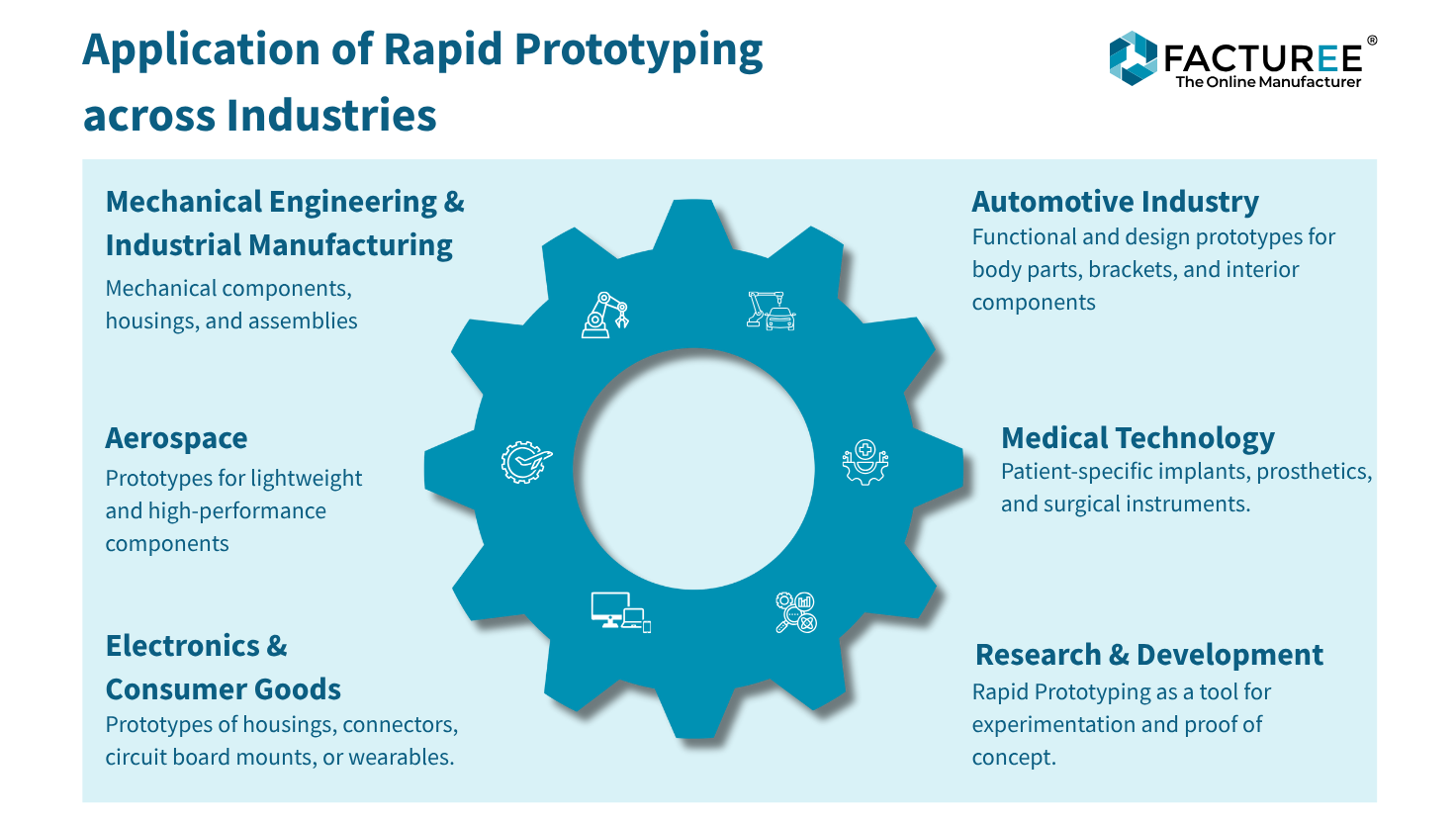
1. Prototypes in Mechanical Engineering and Industry
- Development and testing of mechanical components, Enclosures and Assemblies
- Review of Accuracy of fit, load capacity and function
Use of CNC prototypes or additively manufactured functional samples
Advantage: Faster product development and lower costs for complex components
2. Prototypes in the Automotive Industry
- Production of Functional and design prototypes for body parts, brackets or interior elements
- Simulation of aerodynamic and ergonomic properties
- Testing new materials and production concepts
Advantage: Shorter development times and optimized vehicle components
3. Prototypes in the Aerospace Industry
- Prototypes for Lightweight and high-performance components
- Additive manufacturing of complex geometries that are almost impossible to realize conventionally
- Strict tests on Strength, weight and temperature resistance
Advantage: More efficient development with maximum precision
4. Prototypes in Medical Technology
- Development of patient-specific Implants, prostheses or surgical tools
- Validation of ergonomic designs and biocompatible materials
- Rapid customization of individual solutions for research and clinical use
Advantage: Greater security and individualized products
5. Prototypes in Electronics & Consumer Goods
- Prototypes from Enclosures, plug connections, circuit board holders or wearables
- Tests for Assembly, haptics and user experience
- Iterative improvement of design and function
Advantage: Faster design validation and shorter time to market
6. Prototypes in Research & Development
- Use in universities, start-ups and development departments
- Rapid prototyping as a tool for Experimentation and proof of concept
Combination of simulation and physical test
Advantage: Fast feasibility tests and agile innovation cycles
7. Prototypes in Architecture & Design
- Creation of Models, visualizations and functional studies
- 3D printing of complex structures and concept models
Advantage: Realistic representation of shapes and structures for presentations
What rapid prototyping methods are available?
Sheet metal is mostly used for Rapid prototyping various processes are used to produce prototypes quickly and precisely. They can be divided into three main categories:

Additive processes (3D printing):
Layered construction made of plastic, resin or metal. Ideal for complex geometries, functional samples and small series. Examples: SLA, SLS, FDM, MJF, SLM/DMLS.
Read more about 3D printing at FACTUREE here.

Subtractive processes (CNC machines):
Material is milled or turned from a metal or plastic block. CNC prototypes are thus produced with production-ready dimensions and authentic material properties directly from the drawing. FACTUREE delivers CNC prototypes quickly through a network of more than 2,000 qualified manufacturing partners, ensuring that free machine capacity is available at all times. Read more here about CNC prototypes at FACTUREE.

Replicating processes (casting processes):
Use of forms for series proximity - e.g. Vacuum Casting or Rapid toolmakingEconomical for small series and design tests.
Here you can read more about Injection Molding, Die Casting and Vacuum Casting at FACTUREE.
The choice of procedure depends on the choice of material, accuracy and function from. Additive processes offer maximum flexibility, CNC ensures precision - combined, they enable fast and efficient product development.
How does FACTUREE support rapid prototyping?
FACTUREE offers a comprehensive range of rapid prototyping services for the quick production of functional and design prototypes. With a network of over 2,000 partners and approximately 15,000 machines, development processes are accelerated. The machines are used in the fields of CNC prototyping, 3D printing, sheet metal fabrication, vacuum casting, and rapid injection molding.
Digital 3D CAD models form the basis from which physical parts are created in a short space of time. Typical processes for rapid production include CNC milling, 3D printing and vacuum casting. Customers benefit from a wide selection of materials, a high degree of flexibility for customization and ISO 9001-certified quality.

Renowned companies such as Festo use FACTUREEto produce complex prototype parts quickly and reliably - including surface treatment and assembly. CAD data is uploaded via the digital inquiry tool and the material and process are selected. Production starts immediately with optimal available capacities.
FACTUREE makes rapid prototyping simple: digital processes, tested quality and maximum flexibility - all from a single source.
What are some common questions about rapid prototyping?
What is rapid prototyping?
FACTUREE defines rapid prototyping as a process for the rapid production of prototypes. This process utilizes digital manufacturing technologies such as CNC machining, 3D printing, and vacuum casting.
Here, a physical model is quickly created from a digital CAD model. It represents a product, an assembly, or a component. Rapid prototyping follows the “fail fast, fail cheap” philosophy, so that errors can be identified early and development costs can be reduced.
What methods does FACTUREE use for rapid prototyping?
FACTUREE offers four different manufacturing processes for rapid prototyping. These include additive manufacturing, such as 3D printing, and subtractive processes, such as CNC milling and CNC turning. Replication processes, such as vacuum casting and injection molding, are also used.
The choice of the appropriate process depends on the materials used, the required precision, and the function of the prototype in question. FACTUREE advises customers on the choice of process directly during the digital inquiry process.
How does the rapid prototyping manufacturing process work at FACTUREE?
FACTUREE manufactures prototypes through a structured process consisting of the concept phase, data preparation, manufacturing, testing, and optimization. Customers upload their CAD data via the digital request tool. They select the material and process, and production begins using immediately available capacity from the partner network. This often results in a functional prototype within just a few days.
In which industries does FACTUREE use rapid prototyping?
FACTUREE provides rapid prototyping solutions for industries such as
- Mechanical Engineering,
- Automotive industry,
- Aerospace,
- Medical technology,
- Electronics,
- Consumer goods,
- Research and Development.
Each of these industries has its own specific requirements in terms of precision, materials, and durability. FACTUREE meets these requirements through its certified partner network. Renowned companies such as Festo are already using FACTUREE for complex prototype parts.
How does FACTUREE support rapid prototyping in the electronics industry?
FACTUREE manufactures prototypes of enclosures, connectors, circuit board mounts, and wearables for the electronics industry. Assembly, haptics, and user experience are tested early on, before mass production begins. This shortens development time and enables new electronic products to reach the market faster.
What advantages does FACTUREE's rapid prototyping offer businesses?
FACTUREE uses rapid prototyping to enable faster product development, early defect detection, and lower development costs. In addition, rapid prototyping improves communication between development, purchasing, and production. This is because a tangible prototype provides a common basis for decision-making.
FACTUREE ensures these benefits through ISO 9001-certified quality and a network of over 2,000 certified partners.
Is there an example of rapid prototyping at FACTUREE?
Among other things, FACTUREE has quickly and reliably manufactured complex prototype parts for Festo, including surface finishing and assembly. To do so, the customer uploaded CAD data via the digital request tool and selected the material and manufacturing process directly online. Read more about Festo here.
Projects like these demonstrate how FACTUREE handles rapid prototyping—from the initial digital request to the finished part.
Is Fast Prototyping the same as Rapid Prototyping?
FACTUREE uses "Fast Prototyping" as the standard English equivalent of "Rapid Prototyping." Both terms refer to the same process of rapid, digital prototype production.
Companies looking for fast prototyping services internationally often use the term “fast prototyping,” while “rapid prototyping” is more commonly used in German-speaking countries.
FACTUREE offers both manufacturing approaches using the same processes and the same network of partners.