Hard Anodizing: Processes & Standards for Aluminum Parts
 by Facturee editorial team
Table of contents
- What is Harteloxal?
- What are the key properties of Harteloxal?
- How does hard anodizing work?
- What color is Harteloxal?
- Hard anodizing or hard chrome plating?
- Which aluminum alloys can be hard-anodized?
- How do you correctly specify Harteloxal in a drawing?
- What are the relevant standards for hard anodizing?
- What should buyers look for when it comes to hard anodizing?
Hard anodizing is an anodic oxidation process for aluminum. The coating is typically 25 to 150 µm thick and has a hardness of 400 to 600+ HV. It ensures maximum wear resistance. But how do you correctly account for coating thicknesses and dimensional changes?
Our guide provides you with a wealth of expert knowledge for design and procurement. It covers everything from selecting the right alloy to creating drawings that comply with DIN EN ISO 10074. It also includes a checklist for an optimal procurement process. Learn more here and design components with confidence.
What is Harteloxal?
Hard anodizing (hard anodic oxidation, hard anodizing) is an electrochemical process for producing a hard Al₂O₃ coating on aluminum. The coating is formed through the conversion of the base material. Aluminum is connected as an anode in sulfuric acid and oxidized to Al₂O₃ by direct current.
Hard anodized coatings penetrate the base material by approximately 50 % and grow outward by 50 %. With a coating thickness of 50 µm, the outer diameter increases by approximately 25 µm on each side. This dimensional increase must be specified as an undersize in the drawing.
What are the key properties of Harteloxal?
Based on our many years of experience in the industrial production and validation of coatings, we have compiled these process parameters. They are intended to help you ensure the safe design of your components:
- Definition: Hard anodizing is the anodic oxidation of aluminum under more severe process conditions (0–5 °C, 1.5–3.5 A/dm²) to produce dense Al₂O₃ layers.
- Coating thickness: 25 to 150 µm; industry standard: 25 to 75 µm.
- Precision: Layer thicknesses ranging from 25 to 50 µm are used for precision applications.
- Surface hardness: 400 to 600+ HV, depending on the alloy and process parameters.
- Dimension change: Approximately 50 % of the layer thickness extends outward; an undersize must be specified in the drawing.
- Color: gray to dark gray (depending on the alloy); black only when dyed.
- Standards: DIN EN ISO 10074 (Europe), MIL-A-8625F Type III (U.S. / Aerospace).
The coating exhibits significantly higher wear resistance. The much greater hardness of the resulting ceramic coating also provides excellent electrical insulation.
How does hard anodizing work?
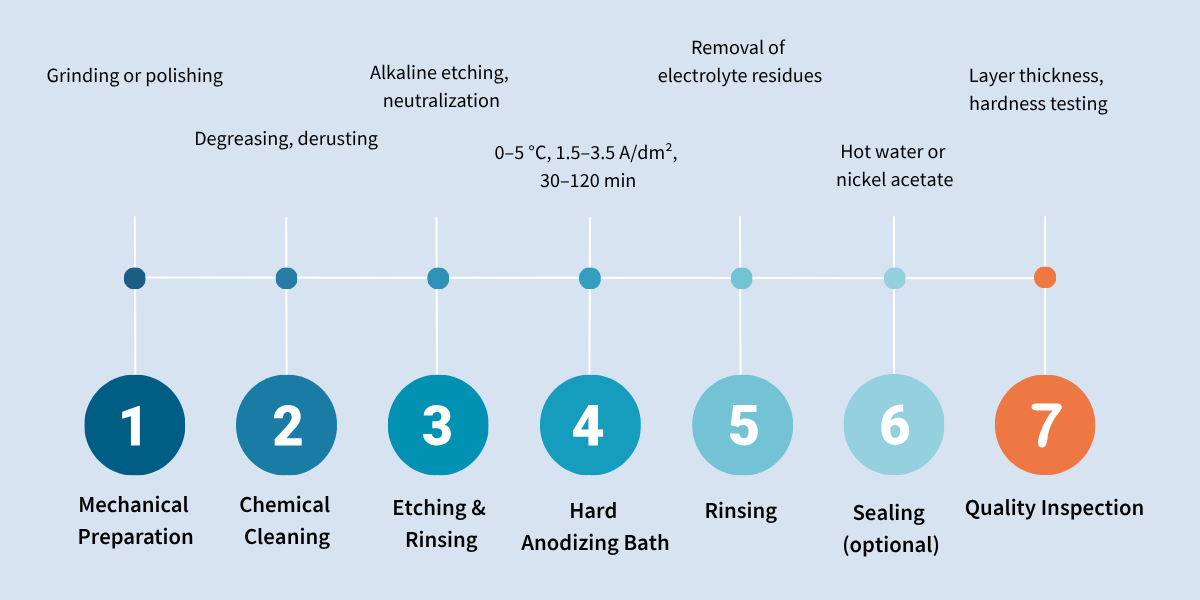
The component is suspended as an anode in a sulfuric acid bath (150 to 200 g/l) at 0 to 5 °C. The aluminum components are immersed in special electrolytes, with higher current densities facilitating the deposition process. The current density (1.5 to 3.5 A/dm²) and process duration (30 to 120 minutes) are tailored to the alloy and the target coating thickness. Optionally, a sealing step follows, which enhances corrosion protection but prevents the retention of lubricants.
Feature |
Standard Anodized |
Hard Anodized |
| Layer thickness | 5 to 25 µm | 25 to 150 µm |
| Layer hardness | 200 to 400 HV | 400 to 600+ HV |
| Bath temperature | 18 to 22 °C | 0 to 5 °C |
| Wear resistance | moderate | High to very high (significantly higher protection) |
| Change in dimensions | low | relevant (≈50 % ingrowth) |
| Color | silver to gray, can be dyed | gray to dark gray |
| Costs | low | moderate to high |
What color is Harteloxal?
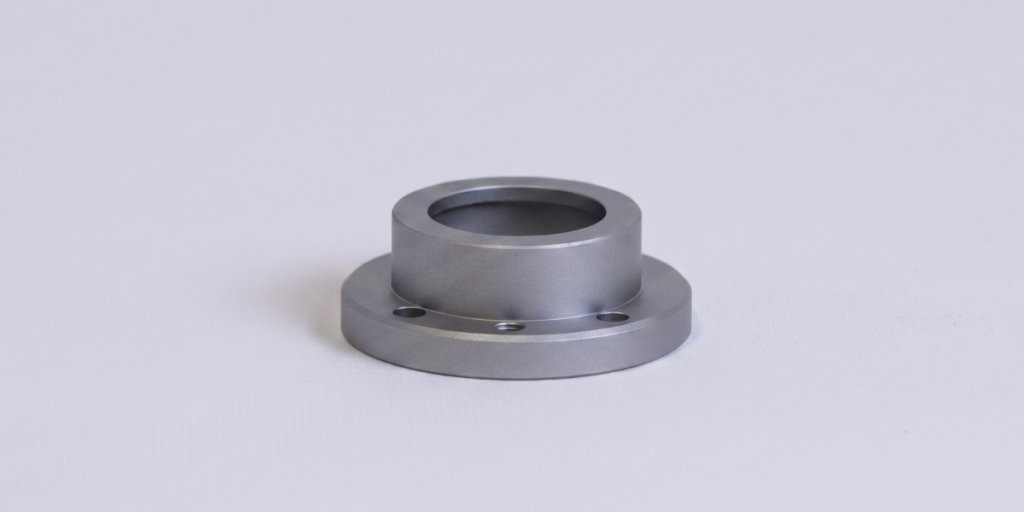
Hard-anodized aluminum components have a natural color ranging from gray to dark gray. The shade depends on the alloy. 6xxx alloys produce lighter shades of gray, while alloys containing copper or silicon produce darker and more uneven coatings.
Black can be achieved by dyeing the material with organic dyes before sealing. It is used in optical systems, camera housings, and control housings.
Can Harteloxal be removed?
Hard anodizing can be removed by chemical leaching in sodium hydroxide solution (NaOH). Since approximately 50 % of the coating has grown into the base material, the part will be undersized relative to the raw part dimensions after removal.
Re-coating over the remaining layer is not recommended. For local corrections to mating surfaces, the layer can be mechanically ground or honed.
Hard anodizing or hard chrome plating?
Hard chrome achieves higher hardness values (850 to 1000 HV) than hard anodizing and can be applied to a wider range of base materials. Hard anodizing is REACH-compliant, lighter, and the more technically and regulatory future-proof choice for aluminum components. Hard chrome relies on chromium-VI chemistry and is subject to REACH SVHC requirements.
Feature |
Hard Anodized |
Hard Chrome |
| Base material | Aluminum alloys | Steel, cast iron, copper |
| Layer hardness | 400 to 600+ HV | 850 to 1000 HV |
| Layer Structure | solid (made from the base material) | Foreign Layer (Material Application) |
| REACH | harmless | Chromium VI, subject to SVHC regulations |
| Typical application | Aluminum pistons, hydraulic housings, gears, worms, housings, and guides | Steel shafts, hydraulic rods |
Which aluminum alloys can be hard-anodized?
The 6xxx series (6061, 6082) is the first choice for hard anodizing. Die-cast parts made of AlSi alloys are not suitable, as the high silicon content interferes with coating formation.
Alloy Series |
Suitability |
Note |
| 1xxx (1050, 1070) | Good | High purity produces a soft layer; the base material has low strength |
| 2xxx (2024, 2017) | Limited | A high copper content reduces coating quality and limits the achievable coating thickness |
| 5xxx (5083, 5052) | Good | Magnesium alloy with good coating quality and corrosion resistance |
| 6xxx (6061, 6082) | Very good | The top choice for Harteloxal; the optimal combination of coating quality and base material properties |
| 7xxx (7075, 7050) | Conditional | Zinc alloy; coating formation is possible, but the process must be coordinated with the coater |
| AlSi die casting | Not suitable | A high silicon content prevents uniform layer formation |
For detailed information on the various alloys and their properties, please read our article on Aluminum and aluminum alloys.
How do you correctly specify Harteloxal in a drawing?
A complete drawing specification for hard anodizing includes the process, standard reference, coating thickness, sealing requirements, and protected and exposed areas. Mating surfaces and holes must be manufactured with an undersize. For a coating thickness of 50 µm, the increase in external dimensions is approximately 25 µm per side.
Parameters |
Example notation in the drawing |
| Procedure and Standard | Hard Anodizing in Accordance with DIN EN ISO 10074 |
| Layer thickness | 50 µm +10/-0 |
| Sealing and Sliding Properties | Without compaction or a PTFE solution as a sealant to improve sliding properties |
| Color | dyed black (if required) |
| Outdoor Areas | Cover the M8 thread; H7 fit with an underdimension of −25 µm |
| Base material | EN AW-6082-T6 |
What are the relevant standards for hard anodizing?
- DIN EN ISO 10074: European standard for hard anodizing of aluminum; specifies coating thicknesses, hardness testing, and acceptance criteria.
- MIL-A-8625F Type III: U.S. military standard for hard anodic coating; Type III without sealing, Type III A with sealing.
- DIN EN ISO 2360: Coating Thickness Measurement (Eddy Current Method).
- DIN EN ISO 4516: Vickers hardness testing for inorganic coatings.
- AMS 2468: Hard Anodizing Process for Aluminum Alloys in the Aerospace Industry (SAE Aerospace).
- NADCAP: Process accreditation for special processes; a mandatory requirement in the aerospace industry.
What should buyers look for when it comes to hard anodizing?
- Certification according to DIN EN ISO 9001; industry-specific AS9100 / NADCAP (aerospace), IATF 16949 (automotive)
- Documented Bath Control: Temperature Log (0–5 °C), Acid Concentration, Current Density per Batch
- Test equipment for coating thickness measurement in accordance with DIN EN ISO 2360 and hardness testing in accordance with DIN EN ISO 4516
- Proof of capability for the required alloy; 7xxx and 2xxx series require process adjustments
- Clear notation on the drawing indicating protected and clear zones
- Documented tolerance management; dimensional changes due to interlayer growth must be accounted for in the process
- Clearly define sealing and coloring requirements in the order specifications
- Clarify component dimensions, lot size, and delivery time in advance
Order Hard Anodizing: Hard Anodizing at FACTUREE
Through its network of more than 2,000 qualified manufacturing partners, FACTUREE offers access to certified hard anodizing facilities in Germany, Europe, and around the world. We identified the right facility for hard anodizing based on alloy, certification, and capacity.
Hard anodizing in accordance with DIN EN ISO 10074 (European standard for hard anodizing of aluminum), MIL-A-8625F Type III (U.S. military standard for hard anodized coatings) and AMS 2468 (hard anodizing process for the aerospace industry), as well as AS9100- and NADCAP-compliant processes, are available upon request.
Through its network of more than 2,000 qualified manufacturing partners, FACTUREE offers access to certified hard anodizing facilities in Germany, Europe, and around the world. We identified the right facility for hard anodizing based on alloy, certification, and capacity.
Hard anodizing in accordance with DIN EN ISO 10074 (European standard for hard anodizing of aluminum), MIL-A-8625F Type III (U.S. military standard for hard anodized coatings) and AMS 2468 (hard anodizing process for the aerospace industry), as well as AS9100- and NADCAP-compliant processes, are available upon request.
Editorial Note: This guide was developed in collaboration with FACTUREE’s manufacturing technology experts, who draw on years of experience in coordinating certified coating processes. We review our content according to internal quality standards and regularly verify it against current DIN standards.