
Casting material: The right material for every casting process
 by Facturee editorial team
The choice of the optimum casting material is the foundation for component quality and cost efficiency. This guide is for engineers and decision-makers. It provides a well-founded overview of mechanical characteristics and the technological castability of the latest metals and polymers. Find out how you can avoid shrinkage cavities and achieve maximum dimensional accuracy through the targeted coordination of material and casting process.
Introduction
Casting is one of the oldest and most versatile manufacturing processes in modern industry. Whether complex engine components, delicate housings or robust industrial fittings, the choice of the right casting material is crucial for the functionality, durability and cost-effectiveness of your component.
This guide will tell you everything you need to know about the most common casting materials, their specific properties and which casting processes they are best suited to.
Why the choice of casting materials is crucial
In contrast to subtractive CNC machining, in which geometries are created by removing material, casting is based on primary shaping through the phase transition from liquid to solid. Read more about casting processes, methods, advantages and disadvantages here.
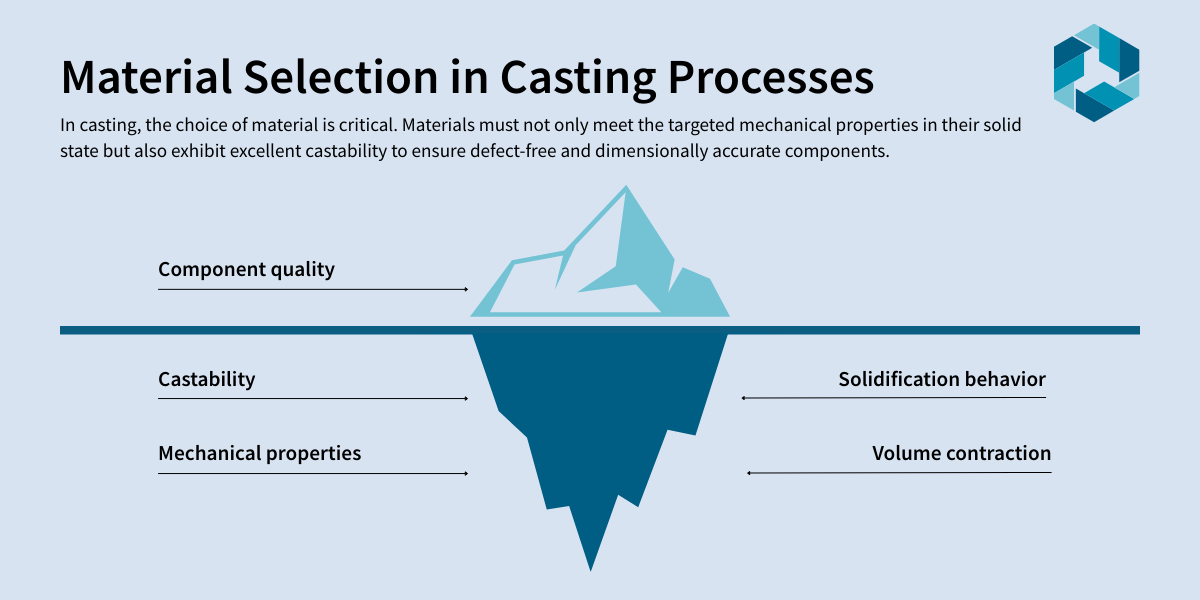
The choice of material is a critical design decision. The material must fulfill the required mechanical characteristics (such as tensile strength and toughness) in the operating state, while at the same time providing excellent Castability have.
This technological property is crucial for process stability and component quality. High castability includes excellent Flow and mold filling capacity, to precisely image even thin-walled cavities, as well as a controlled Solidification behavior. The latter is essential to avoid material-related defects such as Volume contraction (blowhole formation), Shrinkage cracks or Hot cracks to be avoided. Only by coordinating alloys and casting processes can a high level of dimensional accuracy be achieved with minimal scrap.
 More about casting processes at FACTUREE here
Iron casting materials (Ferrous Metals)
Ferrous metals are the backbone of mechanical engineering. They are characterized by high strength, good availability and excellent damping properties.
Cast iron with lamellar graphite (gray cast iron - EN-GJL)
Gray cast iron is the most commonly used casting material. The graphite it contains is in lamellar form, which gives the material its characteristic properties.
- Properties: High compressive strength, excellent vibration damping, outstanding thermal conductivity and very good machinability.
- Applications: Engine blocks, gearbox housings, brake disks, machine tool beds.
Cast iron with spheroidal graphite (nodular cast iron - EN-GJS)
By adding magnesium, the graphite forms spheres instead of lamellae. This eliminates the notch effect of the lamellae and makes the material significantly more resilient.
- Properties: Mechanical properties similar to steel, high tensile strength, good toughness and ductility.
- Applications: Crankshafts, safety components in vehicle construction, pipelines for high pressure.
Malleable cast iron (EN-GJM)
Malleable cast iron occupies an intermediate position between cast iron and cast steel. Long-term annealing treatment (tempering) makes the cast iron tough and malleable.
- Applications: Thin-walled small parts, fittings, locks, chassis parts.
Cast steel (EN-GJS)
Cast steel is used when the strength of cast iron is insufficient or good weldability is required for composite structures.
- Properties: Highest toughness, weldable, individually alloyable (e.g. heat-resistant or corrosion-resistant).
- Applications: Turbine housings, heavy fittings, components for plant engineering.
Non-ferrous metals during casting
Non-ferrous metals score points above all for their low weight, specific conductivity and extreme corrosion resistance.
Aluminium alloys
Aluminum is the star in lightweight construction and can be processed particularly economically in die casting.
- Properties: Low density, very good corrosion resistance, high thermal conductivity.
- Applications: Enclosures for electronics, automotive components, aerospace.
Magnesium alloys
If maximum weight savings are required, magnesium is the first choice (lighter than aluminum).
- Properties: Extremely light, high strength-to-weight ratio, good cushioning.
- Applications: Housings for laptops and cell phones, steering wheels, lightweight structural components.
Titanium alloys
Due to its reactivity, titanium is usually processed under vacuum in investment casting.
- Properties: Highest specific strength, biocompatible, extremely corrosion-resistant to seawater and acids.
- Applications: Implants, turbine components, aerospace.
Zinc alloys (Zamak)
Zinc is ideal for mass-produced items with maximum precision.
- Properties: Low melting point, extremely thin-walled castable, excellent for galvanic coatings.
- Applications: Fittings, toys, small precision parts.
Copper alloys (bronze & brass)
- Properties: Excellent sliding and wear properties (bronze), high electrical conductivity, decorative appearance.
- Applications: Bearing bushes, ship propellers, cast iron, water-bearing fittings.
Special materials and plastics
In addition to metals, composite materials and polymers are expanding the spectrum of foundry technology.
Mineral casting (polymer concrete)
A composite material made of mineral fillers and epoxy resin, which is poured cold into molds.
- Advantage: Extreme vibration damping and thermal inertia.
- Application: Racks for high-precision machine tools.
Plastics in the casting process
- Vacuum casting (polyurethane - PUR): Ideal for prototypes and small series. Simulates properties of series plastics such as ABS or rubber.
- Injection molding (thermoplastics): The standard process for the mass production of polymer components (PA, PP, PEEK).
Which casting process for which material?
Not every material can be optimally processed with every method. Here is a brief guide:
| Procedure | Typical materials | Lot sizes | Special feature |
|---|---|---|---|
| Sand casting | Gray cast iron, steel, aluminum | 1 to medium series | Cost-effective mold making |
| Die Casting | Aluminum, magnesium, zinc | Large series | High cycle rates, thin-walled |
| Investment casting | Stainless steel, titanium, bronze | Small to medium | Highest level of detail |
| Gravity die casting | Aluminum, brass | Medium series | Good mechanical properties |
| Vacuum Casting | Polyurethane (PUR) | 5-50 pieces | Fast prototype construction |
The perfect casting at FACTUREE
The theory of material selection is complex - the procurement of your components doesn't have to be. As an online manufacturer FACTUREE gives you direct access to a global network of specialized foundries. Whether you need filigree prototypes in vacuum casting or heavy-duty series components made of nodular cast iron: We get your project into the right shape.
Why FACTUREE is the first choice for your castings:
- Unlimited variety of materials: We cover the entire spectrum - from standard aluminum alloys and grey cast iron to highly reactive titanium or heat-resistant superalloys.
- Advice independent of proceedings: We are not restricted to one process. Whether sand, pressure, precision or permanent mold casting - we select the most economical solution for your geometry and batch size in a technologically neutral way.
- Integrated quality assurance: Our ISO 9001-certified quality management system ensures that your components correspond exactly to the specified mechanical characteristics and tolerances.
- Everything from a single source: From the first casting to the final CNC post-processing and surface finishing, we take care of the entire project management for you.