
The path from digital idea to precise component requires a decisive decision: CNC milling or CNC turning? For engineers and purchasers, this is not a technical subtlety, but a strategic decision that directly determines costs, quality and time to market. A wrong decision is expensive - this article provides the sound basis for avoiding it and choosing the optimum process for each project.
Table of contents
From the digital idea to the precise component
CNC machining is a cornerstone of modern manufacturing and enables the precise production of complex workpieces from a wide range of materials. The production of a precise component from digital 3D data requires the selection of the appropriate CNC process. CNC milling and CNC turning are the most common techniques, but are based on fundamentally different principles. Engineers who design new products and purchasers who need to ensure efficient production are regularly faced with a crucial question: which machining process is the right one for their specific project? A superficial answer is not enough in this context. The choice between CNC milling and CNC turning not only influences the technical feasibility and achievable precision, but also has a significant impact on production costs and the final time to market. A wrong decision can result in unnecessary costs or an unfinished design.
This article explains the differences and typical applications of both methods. It offers a well-founded decision-making aid so that you always choose the right method for your project.
The processes in direct comparison

The fundamental difference between CNC milling and CNC turning lies in the kinematics of the machining process, i.e. which component - the workpiece or the tool - performs the main rotational movement. This fundamental principle determines all subsequent features of the processes, from the possible geometries to the tools used.
What is CNC milling? The universal shaping tool
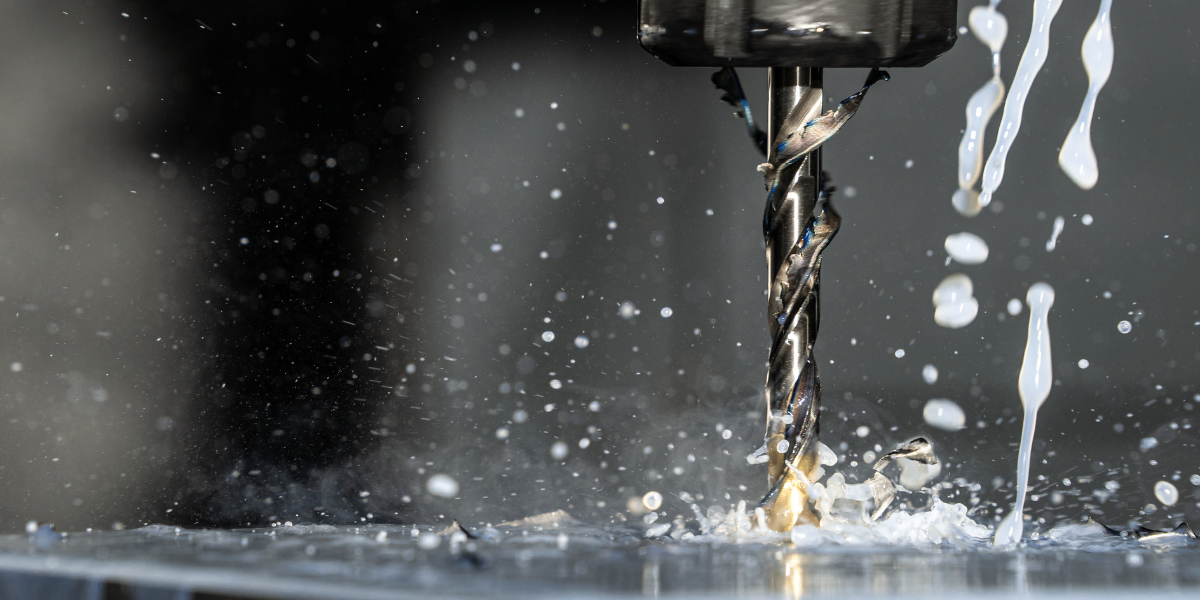
In CNC milling, the component is stationary while a rotating cutting tool (the cutter) moves and removes material. Think of it as a high-precision drill that can move in all directions to create contours, pockets and free-form surfaces. The cutting is done by a rotating multi-cutting tool (the cutter) that moves along multiple axes around the stationary part to remove material. This method is extremely flexible and enables the production of complex, irregular or flat surfaces. Typical features created by CNC milling are pockets, grooves, slots, 3D contours and drilled holes. Milling is carried out on machines with different numbers of axes, with 3-axis machines enabling linear movement in the X, Y and Z axes. More advanced 4- or 5-axis machines offer additional rotary axes that allow the machining of the most complex geometries and free-form surfaces.
Milling is ideal for "angular" or prismatic parts and complex 3D contours. Typical areas of application are
- Flat surfaces, steps and grooves
- Pockets and drill holes
- Complex free-form surfaces
Examples of milled parts include housings for electronics, front panels, heat sinks, fixtures and brackets. With modern 5-axis milling machines, even extremely complex components can be machined from several sides in a single clamping operation, which increases precision and efficiency.
What is CNC turning? The specialist for everything round
In CNC turning, it is the other way around: the component rotates around an axis at high speed while a fixed cutting tool removes material. Think of a potter's wheel that shapes the outer or inner form. In CNC turning, the workpiece rotates around its own axis at high speed. A stationary or slow-moving cutting tool, called a turning tool, moves along the surface of the component and removes precise layers of material to create the desired shape. The movement of the tool is typically limited to two axes - the radial X-axis and the axial Z-axis - which severely restricts the geometries to rotationally symmetrical shapes. Therefore, this process is primarily suitable for the production of parts such as shafts, bolts, pins, bushes and flanges. Although there are modern turning centers that can also perform limited milling operations with driven tools, the basic principle of dominant component rotation remains unchanged.
Turning is the process of choice for all rotationally symmetrical, i.e. "round" or cylindrical components. Typical areas of application are
- Shafts and axles
- Screws, bolts and pins
- Rings, bushes and flanges
Examples of turned parts include drive shafts, fittings, nozzles and housing covers. Turned parts can also be provided with milled elements such as cross holes or wrench flats on turn-mill centers, which further increases the versatility of this process.
The evolution of CNC manufacturing: Hybrid approaches

Modern manufacturing is constantly evolving to overcome the limitations of traditional processes. Hybrid solutions combine the best of different worlds and significantly increase efficiency.
Five-axis milling: The power of additional axes
A 5-axis milling machine extends the traditional 3-axis movement with two additional axes of rotation. This makes it possible to tilt and swivel the workpiece or tool so that up to five sides of a component can be machined in a single set-up.
The use of 5-axis milling machines has the following advantages:
- Reduced set-up time: Fewer reclamping operations minimize set-up times and human error sources, which increases repeatability and precision.
- Improved quality: The use of shorter and stiffer tools reduces vibrations and ensures a better surface finish.
- Greater complexity: Complex free-form surfaces and undercuts that would not be possible on a 3-axis machine can be machined without any problems.
These advantages can compensate for the higher acquisition and maintenance costs of 5-axis machines, as they drastically reduce the overall machining time per complex part.
Turn-mill centers: The best of both worlds
Turn-mill centers combine the functionalities of a lathe and a milling machine. Where previously different machines and reclamping processes were necessary, a single machine can now completely process the component. This eliminates set-up times between processes, reduces throughput time and increases quality by avoiding manual errors. These machines are ideal for complex, rotationally symmetrical parts that also have milled features such as key widths, grooves or bores.
The trend in modern manufacturing is therefore moving away from individual, specialized processes towards integrated, hybrid solutions that increase efficiency and enable complete machining from a single source.
The decisive role of design (DFM)
The greatest leverage for cost reductions does not lie in the manufacturing process itself, but in the design phase of a component. This is where the principle of "Design for Manufacturability (DFM) into play. This approach gears the design towards efficient and cost-effective production right from the start.
Design decisions are responsible for up to 70 % of the final manufacturing costs. Close collaboration with the manufacturing partner as early as the design phase can therefore identify hidden costs and achieve significant savings.
The application of DFM principles makes it possible to identify expensive, difficult to implement or unnecessary features at an early stage. A simple design adjustment can significantly reduce the processing time or drastically reduce the number of reclamping operations.
Decision-making aid: Which process is right for your project?
Choosing the right CNC process depends on the geometry, complexity and specific requirements of your component. Use this checklist to help you make the right decision:
- Analyze geometry: Is your component primarily rotationally symmetrical and predominantly round? Then CNC turning the most cost-effective and fastest method. For round parts with additional features such as cross holes or wrench flats, a combination of turning and milling, the Turn-millthe ideal solution. If your component is not rotationally symmetrical, but has prismatic or complex free-form shapes, the CNC-milling procedure the appropriate procedure.
- Evaluate complexity: Consider how many axes are required for machining. Simple 2.5D geometries can be efficiently machined on a 3-axis machine can be manufactured. For complex free-form surfaces or undercuts, a 5-axis machine which allows a higher processing complexity.
- Consider the number of units: Consider the quantity of your project. With Small series or prototypes, the set-up costs per part can be very high. With large batch sizes the set-up costs are quickly amortized, as the effective unit costs are reduced.
- Specify tolerances and surface quality: Define the required precision. Very high precision or a special surface finish significantly increases production costs. Ensure that the required quality corresponds to the component function to avoid unnecessary costs.
- Apply DFM principles: Critically check your design for unnecessary complexity. The use of Design for Manufacturability (DFM)-The use of the same principles in the design phase can shorten the processing time and reduce the number of reclamping operations. This allows you to massively reduce production costs even before the start of production.
Your next step
The choice between CNC milling and CNC turning does not depend on which process is better, but which is best suited to your project. CNC turning is ideal for the cost-efficient series production of rotationally symmetrical components. CNC milling offers unparalleled flexibility for complex and irregular shapes. The evolution to hybrid machines such as 5-axis milling machines and turn-mill centers reflects the need for integrated solutions that eliminate the biggest cost drivers, especially set-up times.
No matter which process is right for your project - we make implementation as easy as possible for you. Upload your CAD file now. Our system will automatically analyze your geometry and provide you with a quote promptly.
Our team of experts will be happy to advise you at an early stage or answer any questions you may have. Find out more here.