More than just burnt edges: The secret to wood laser cutting is sublimation - the vaporization of the material using pure energy. Discover how this precise technology works, why MDF is often better than solid wood and how a digital file becomes a perfect component.

Introduction
The precision of laser cutting wood is based on a fascinating physical principle: sublimation. Instead of cutting the material, a highly concentrated CO2 laser beam vaporizes the material without touching it. This introduction gives you an overview of our technical guide. We analyze the interaction between laser and wood, compare the suitability of different materials such as MDF and plywood for the process and explain the components of the overall CNC-controlled system. A must-read for anyone who wants to understand the technology behind perfect cutting results.
How is wood cut with a laser?
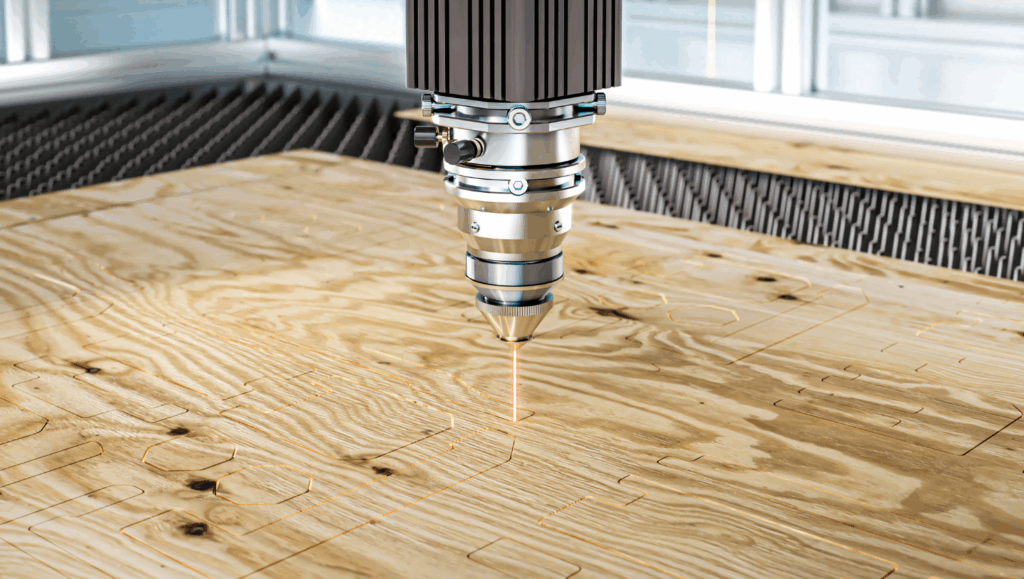
Laser cutting of wood is a high-precision, thermal cutting process based on the principle of sublimation instead of mechanical removal of material. The core of the process is a powerful CO2 laser, whose invisible beam of light is focused through a lens system onto an extremely small spot, often less than 0.2 millimeters in diameter. When this concentrated beam of energy hits the surface of the wood, the material is heated so abruptly that it does not burn, but changes directly from a solid to a gaseous state. This process, known as sublimation, virtually vaporizes the wood at the cutting line.
The entire operation is controlled by a computer that reads the exact paths from a digital vector file (such as DXF or SVG). The laser head moves precisely over the wooden panel and follows the specified contours. During the cutting process, a crucial auxiliary process is the use of compressed air, also known as "air assist". A fine nozzle continuously blows a targeted stream of air directly into the cutting gap. This has a double benefit: Firstly, smoke and vaporized material are removed immediately, ensuring a clean and efficient cut. Secondly, the airflow prevents open flaming of the wood and cools the surrounding material, minimizing the heat-affected zone.
The result of this non-contact process is components of outstanding precision that enable even the most intricate geometries. A characteristic feature is the dark cutting edge created by carbonization, which is often appreciated as an aesthetic design feature and seals the wood at the same time. As there are no mechanical forces acting on the workpiece, there is no tool wear or risk of warping, making the method ideal for processing delicate or complex wooden parts.
If you would like to find out more about laser cutting, you can find more information here.
The best wood for laser cutting and its properties

Choosing the right wood is crucial for optimum laser cutting results. In general, the most suitable woods are those with a uniform density, a fine grain and a low resin content. Three materials have proven to be particularly advantageous:
Poplar plywood

This is the all-rounder and often the first choice for many projects. Poplar is a very light and soft wood, which enables cutting with lower laser power and fast processing times.
- Properties: Light in color, which results in excellent contrast when engraving. The homogeneous, fine structure ensures clean cut edges with only slight smear marks. It is also very cost-effective.
- Ideal for: Model making, decorative elements, prototypes and creative handicrafts
Birch plywood

Birch plywood is the best choice for projects that require more stability and a higher quality look. It is significantly denser and more robust than poplar.
- Properties: Very stable and dimensionally stable thanks to cross-laminated veneer layers. The fine, even grain enables extremely precise cuts and very detailed engravings. The cut edge is clean and honey-brown.
- Ideal for: Functional components, high-quality signs, durable housings and sophisticated gift items.
Medium-density fiberboard (MDF)

MDF is not natural wood, but a wood-based material made from compressed fibers. Its absolute homogeneity makes it unique for laser use.
- Properties: Completely free of knots and grain, resulting in absolutely even cuts and engravings. The smooth surface is perfect for sharp details and varnishing. However, the cut edges are usually very dark to black.
- Ideal for: Stencils, technical components, lettering and projects that are to be painted opaque.
While solid woods such as oak or maple can also be engraved, their uneven density and grain is often a challenge when cutting. For precise and repeatable results, plywood and MDF are therefore the superior materials.
Which tool for laser cutting wood?
The key tool for laser cutting wood is a CO2 laser cutter. Other laser types such as fiber lasers are unsuitable for this, as their wavelength is reflected instead of absorbed by the wood. The CO2 laser, on the other hand, emits light in the infrared range (10,600 nm), which is perfectly absorbed by organic materials such as wood, plywood or MDF. This efficient energy transfer leads to sudden vaporization (sublimation) of the material.
However, the tool is more than just the laser beam. It is a complete computer-controlled system (CNC). A movable laser head precisely traces the contours that are specified in a digital vector file (e.g. DXF, SVG). The power of the laser, measured in watts, determines the maximum material thickness and speed that can be cut. Depending on the type of wood and thickness, lasers with 50 to over 100 watts are common in order to achieve precise and clean results.
What seals are there for laser cutting wood?
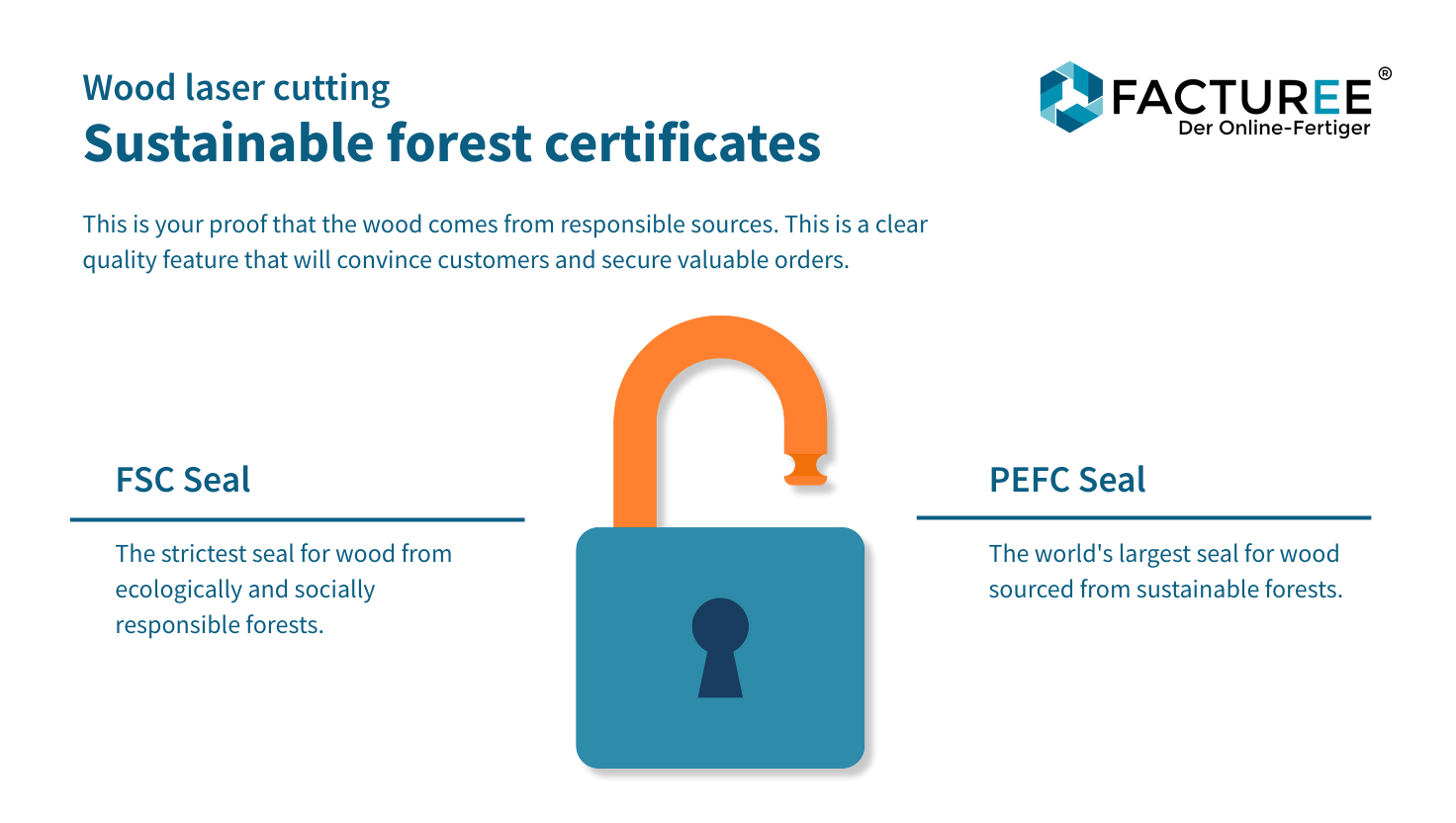
There are internationally recognized certifications for projects that require explicit proof of sustainable forest management:
- FSC® (Forest Stewardship Council): This strict international seal guarantees that wood products come from forests that are managed according to demanding ecological and social principles. The FSC system safeguards the rights of indigenous peoples, protects endangered species and preserves the forest ecosystem.
- PEFC™ (Program for the Endorsement of Forest Certification): PEFC is the world's largest institution for ensuring and marketing sustainable forest management. The seal confirms that wood and paper products originate from forests that are managed in an ecologically, economically and socially sustainable manner.
Advantages and disadvantages of laser cutting wood
| Advantages | Disadvantages |
|
|
Your online manufacturer for laser cuts from wood

As an online manufacturer with a network of over 2,000 manufacturing partners, FACTUREE does not source materials from a single location, but uses a broad, international supplier network. The focus here is on Quality and sustainability the supply chain. Many of the manufacturing partners, especially the most important ones, are certified in accordance with the environmental management standard ISO 14001 certified. This ensures that environmentally friendly production processes are adhered to.